
You have secured an investor meeting.
Your pitch deck explains the opportunity, your traction is promising, and your fundraising ask appears clear. Then the investor asks:
“Can you walk me through the financial model?”
This is where a strong story must hold up against the numbers.
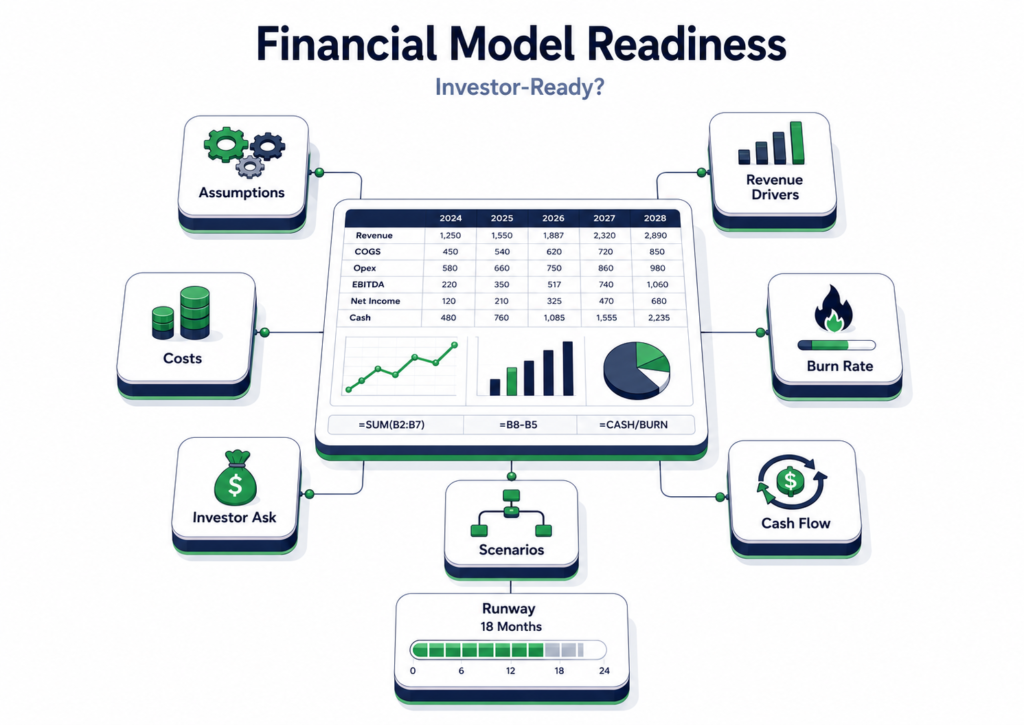
An early-stage financial model does not need to predict the future perfectly. Investors know that customer growth, hiring dates, pricing, and market conditions will change. What they expect is a model that shows you understand:
- How the business generates revenue
- What drives growth
- What growth will cost
- How quickly the company uses cash
- How much capital is required
- Which milestones the round should achieve
A polished spreadsheet with weak assumptions will not build confidence. A clear model based on reasonable business drivers will.
Here is how to review your financial model before presenting it to investors.
1. Make the Model Easy to Navigate
An investor should not need to search through twenty tabs to find your revenue forecast, expenses, or cash position.
A practical financial model may include:
| Tab | Purpose |
|---|---|
| Summary | Key financial results and fundraising requirements |
| Assumptions | Pricing, customer growth, hiring, and cost drivers |
| Revenue | How sales are calculated |
| Team | Hiring dates, salaries, and employment costs |
| Operating Costs | Marketing, software, legal, rent, and other expenses |
| Profit and Loss | Revenue, costs, and profitability |
| Cash Flow | Cash entering and leaving the business |
| Scenarios | Base, upside, and downside outcomes |
| Fundraising | Capital required, allocation, runway, and milestones |
Use consistent formatting throughout the model.
Inputs should be clearly separated from formulas, units should be obvious, and dates should follow one format. Avoid unexplained abbreviations and hidden calculations.
The model should be detailed enough to support your conclusions but simple enough to explain during a meeting.
2. Build the Forecast From Business Drivers
The most important part of your model is not the final revenue number.
It is the logic that produces it.
Founders sometimes begin with a target such as:
“We want to reach $5 million in revenue within three years.”
They then increase monthly revenue until the model reaches that target.
Investors will approach the forecast from the opposite direction:
- How many customers are required?
- What will each customer pay?
- How quickly can they be acquired?
- How many salespeople are needed?
- How many customers will leave?
- What resources are required to serve them?
Your forecast should be built from measurable drivers.
For a subscription company, these may include:
- New customers per month
- Average subscription price
- Customer churn
- Contract length
- Expansion revenue
- Free-to-paid conversion
- Sales-cycle length
For a product company, they may include:
- Units sold
- Average selling price
- Production cost
- Wholesale and direct-sales mix
- Returns
- Inventory requirements
- Distribution fees
For a marketplace, they may include:
- Active buyers and sellers
- Transaction volume
- Average order value
- Take rate
- Purchase frequency
- Refunds or cancellations
The financial statements should be the result of these assumptions—not a collection of manually entered targets.
3. Test Whether Revenue Growth Is Operationally Possible
Rapid growth is not automatically unrealistic. It becomes difficult to believe when the model does not show how the company will create it.
Suppose your forecast shows revenue increasing from $600,000 to $4 million within two years.
The model should explain:
- How many new customers are needed
- How those customers will be reached
- How long they take to convert
- How many sales or marketing resources are required
- Whether the product can support the additional volume
- How much customer churn is expected
Revenue growth should connect to the go-to-market plan in your pitch deck.
When the deck says your company will grow through channel partnerships, the model should show when those partnerships begin generating opportunities and how many customers they may produce.
When the deck says you will build an enterprise sales team, the forecast should include hiring dates, ramp-up periods, sales capacity, and longer contract cycles.
A forecast becomes more credible when the path to revenue is visible.
4. Use Historical Performance Wherever Possible
When your company already has operating history, future assumptions should be connected to past results.
Useful historical data may include:
- Monthly revenue
- Number of customers
- Average contract value
- Conversion rates
- Customer churn
- Gross margin
- Sales-cycle length
- Marketing efficiency
- Headcount
- Monthly burn
Investors may compare your forecast with previous performance.
If the company has historically grown 5% per month but the model assumes immediate growth of 18% per month, be prepared to explain what changes.
The reason may be valid:
- A new sales team
- A recently launched product
- A signed distribution agreement
- Expansion into another market
- Increased production capacity
- A stronger conversion rate
The model should make that change visible.
Historical performance does not need to limit ambition. It should provide the foundation for explaining why future results may improve.
5. Make Revenue Quality Visible
Not all revenue has the same value.
Investors may want to understand:
- Whether revenue is recurring or one-time
- Whether customers are concentrated
- Whether contracts are signed or projected
- Whether growth comes from new customers or price increases
- Whether discounts are being used to win business
- Whether customers remain over time
For example, $1 million in annual revenue from 200 recurring customers may carry a different risk profile from $1 million generated by one large project.
Your model may need to separate:
- Recurring subscriptions
- Setup or implementation fees
- Transaction revenue
- Professional services
- Hardware sales
- Licensing revenue
- Other income
This helps investors understand which parts of the forecast are predictable and which are less certain.
6. Calculate Gross Margin Correctly
Gross margin shows how much revenue remains after the direct costs of delivering the product or service.
The basic calculation is:
Gross profit = Revenue − Cost of goods sold
Gross margin = Gross profit ÷ Revenue
Direct costs may include:
- Manufacturing
- Packaging
- Shipping
- Payment-processing fees
- Cloud infrastructure tied to product usage
- Customer-support costs directly required for delivery
- Third-party licences
- Contractor costs associated with customer projects
A common modelling mistake is placing direct delivery expenses under general operating costs. This can make gross margin appear stronger than it really is.
Your cost classification should remain consistent across historical results and forecasts.
Investors may also examine how margin changes as the business grows.
A software company may expect margin to improve with scale. A consumer-product company may improve margin through larger production volumes. A service-heavy business may have less room for expansion.
Explain the operational reason behind any major improvement.
7. Make Costs Grow With the Business
Revenue should not grow rapidly while expenses remain almost unchanged.
Growth usually requires additional investment in:
- Employees
- Sales and marketing
- Product development
- Customer support
- Technology infrastructure
- Legal and compliance
- Production capacity
- Inventory
- Market expansion
Review each major growth assumption and ask:
What must the company spend to make this happen?
If customer volume triples, will the existing support team be enough?
If you enter two new countries, have you included local staff, legal advice, marketing, travel, and operating costs?
If you launch a hardware product, have you included manufacturing deposits, shipping, storage, and inventory timing?
Your expense plan should represent the company described in the pitch deck.
8. Build a Role-by-Role Hiring Plan
For many startups, payroll is the largest expense.
Avoid using one general line called “team growth.”
Your hiring plan should show:
- Role
- Department
- Start date
- Salary
- Employer costs and benefits
- Recruitment expenses
- Expected contribution to the business
| Planned Hire | Timing | Purpose |
|---|---|---|
| Senior Engineer | Month 2 | Complete the enterprise product |
| Sales Lead | Month 4 | Build the sales process |
| Account Executives | Months 6–9 | Increase customer acquisition |
| Customer Success Manager | Month 8 | Support onboarding and retention |
| Finance Manager | Month 12 | Improve reporting and controls |
Include realistic hiring delays.
A person planned for month three may not begin contributing immediately. Sales hires may require several months to reach full productivity, while technical hires may need time to understand the product.
Your model should reflect these ramp-up periods when they materially affect revenue or costs.
9. Understand Burn Rate and Runway
You should be able to explain your burn rate and runway without searching through the spreadsheet.
Gross burn is the company’s total monthly cash spending.
Net burn is the amount of cash the company loses after cash revenue is considered.
For example:
- Monthly cash expenses: $140,000
- Monthly cash revenue: $55,000
- Net burn: $85,000
Runway estimates how long the company can continue operating before cash is exhausted.
However, simply dividing current cash by current burn may be misleading.
Burn may increase after:
- New hires
- Product launches
- Market expansion
- Higher marketing investment
- Increased infrastructure usage
- Inventory purchases
Your cash-flow forecast should show:
- Starting cash
- Monthly cash inflows
- Monthly cash outflows
- Net burn
- Closing cash balance
- Lowest cash point
- Expected funding date
- Cash remaining at the end of the forecast
The lowest cash point matters because it shows when the business becomes financially vulnerable.
10. Include Working Capital Where It Matters
Profit and cash are not the same.
A company can record revenue while waiting several months to receive payment. It can also pay suppliers before products are sold.
Working-capital requirements may include:
- Customer payment terms
- Supplier payment terms
- Inventory
- Deposits
- Prepaid expenses
- Taxes
- Receivables
- Refund timing
This is especially important for:
- Consumer products
- Manufacturing
- Marketplaces
- Wholesale businesses
- Companies with long enterprise payment cycles
A company may appear profitable in the profit-and-loss statement while still running out of cash.
Your model should reflect when money is actually received and paid.
11. Make the Model Match the Pitch Deck
Your financial model and pitch deck should tell one consistent story.
| Pitch Deck Statement | Financial Model Check |
|---|---|
| Revenue target | Is it supported by customer and pricing assumptions? |
| Market expansion | Are launch and operating costs included? |
| Hiring plan | Are roles, salaries, and dates shown? |
| Product roadmap | Are development costs reflected? |
| Use of funds | Does spending match the proposed allocation? |
| Runway | Does cash flow support the stated period? |
| Milestones | Can they be achieved within the forecast timeline? |
Inconsistencies create unnecessary doubt.
If the deck says you are raising $2 million for 18 months of runway, the cash-flow model should support that statement.
If the deck says you will hire 12 people, those employees should appear in the hiring schedule.
If the deck says you will reach $3 million ARR, the revenue model should show how many customers and contracts are required.
Review the two documents together before every investor meeting.
12. Build Base, Upside, and Downside Scenarios
A financial model should not assume that everything goes according to plan.
Create at least three scenarios.
Base Case
The outcome you consider most realistic based on current evidence.
Upside Case
A stronger outcome created by faster customer acquisition, higher pricing, better retention, or stronger market performance.
Downside Case
A more conservative outcome in which sales take longer, customers convert more slowly, expenses increase, or fundraising is delayed.
Your scenarios should change the business drivers—not only the final revenue number.
For example, a downside case may include:
- Longer sales cycles
- Lower conversion
- Delayed hiring
- Higher churn
- Reduced pricing
- Slower market entry
- Additional operating expenses
Scenario planning helps you answer:
- What happens if revenue is 25% below plan?
- How much runway remains?
- Which hires can be delayed?
- Which expenses can be reduced?
- When would another round be required?
- Can the company still reach a meaningful milestone?
A strong downside case shows that the founders understand risk and have considered how to respond.
13. Connect the Fundraising Amount to Milestones
Your fundraising amount should come from the operating plan.
Start by defining what the company needs to achieve before the next round.
Possible milestones include:
- Completing the product
- Reaching a revenue target
- Proving customer retention
- Building a repeatable sales channel
- Entering a new market
- Securing regulatory approval
- Increasing production capacity
- Reaching break-even
Then calculate:
- The resources required
- The expected monthly burn
- The time needed
- A reasonable contingency buffer
Your ask should explain the result of the investment.
Instead of:
We are raising $1.8 million for product, marketing, and hiring.
Use:
We are raising $1.8 million to complete the enterprise product, build the initial sales team, and grow from $400,000 to $1.7 million ARR over approximately 18 months.
The second version connects capital to measurable progress.
14. Include a Realistic Cash Buffer
Financial models often assume that the company will raise the next round just before cash reaches zero.
That is risky.
Fundraising can take longer than planned, and operating results may fall below the base case.
A reasonable model should include a buffer for:
- Fundraising delays
- Unexpected hiring costs
- Product delays
- Customer-payment delays
- Legal or compliance expenses
- Lower-than-expected revenue
- Economic uncertainty
The appropriate buffer depends on the business, but the company should not plan to reach its next milestone with no remaining flexibility.
Investors want to know that the round is large enough to create meaningful progress—not merely postpone a cash crisis.
15. Know the Difference Between Profitability and Fundability
A company does not necessarily need to become profitable during the current forecast period.
However, investors will want to understand:
- Whether profitability is possible
- What scale is required
- Which costs are temporary
- Whether margins improve
- How many future rounds may be needed
- Whether the business can become self-sustaining
Your model should make the path visible.
This may mean showing when:
- Gross profit covers operating costs
- Contribution margin becomes positive
- Customer-acquisition payback improves
- Fixed costs grow more slowly than revenue
- The company reaches cash-flow break-even
The goal is not to force an early break-even date into the model. It is to show that the business economics can eventually work.
16. Prepare to Explain the Model in Plain Language
Investors may not review every spreadsheet row during the first meeting.
They are more likely to focus on the key drivers.
Be ready to explain:
- How revenue is calculated
- Why pricing is reasonable
- How customers are acquired
- What churn you assume
- What drives gross margin
- Which hires are essential
- How burn changes after the round
- How much runway the investment provides
- Which milestones the company should reach
- When another round may be required
Avoid answering:
“That number comes from the spreadsheet.”
Explain the business logic.
A useful answer might be:
“Our current annual contract value is based on the first 18 paying customers. The base case keeps pricing close to the current level, while the upside case includes the enterprise package planned for next year.”
You do not need to defend the forecast as a certainty.
You need to show that you understand why the model produces each major result.
Questions Investors May Ask About Your Financial Model
| Area | Likely Investor Question |
|---|---|
| Revenue | What assumptions drive customer growth? |
| Pricing | Is this based on current customers or future plans? |
| Sales | How many opportunities can each salesperson manage? |
| Churn | What percentage of customers do you expect to lose? |
| Gross Margin | Which direct costs have been included? |
| Hiring | Why is each role needed at this time? |
| Burn | How does monthly spending change after the round? |
| Runway | When does the company reach its lowest cash point? |
| Scenarios | What happens if growth is slower than expected? |
| Fundraising | Why are you raising this exact amount? |
| Milestones | What should the company achieve before the next round? |
| Break-Even | At what scale can the business become sustainable? |
Final Financial Model Review Checklist
| Review Area | Final Question |
|---|---|
| Structure | Can someone navigate the model without your help? |
| Assumptions | Are all major business drivers clearly shown? |
| History | Do historical results match company records? |
| Revenue | Is growth tied to customers, pricing, and conversion? |
| Costs | Do expenses increase realistically with growth? |
| Margins | Are direct costs classified correctly? |
| Hiring | Are roles, salaries, dates, and ramp-up periods included? |
| Cash Flow | Does the model reflect when cash is actually received and paid? |
| Burn Rate | Do you know the current and projected net burn? |
| Runway | Does the funding amount support the claimed timeline? |
| Scenarios | Are base, upside, and downside cases included? |
| Consistency | Does the model match the pitch deck? |
| Fundraising Ask | Is the amount connected to milestones and a cash buffer? |
| Presentation | Can you explain the main assumptions in plain language? |
| Formula Check | Have errors, broken links, and hard-coded outputs been removed? |
A Strong Financial Model Explains the Business
Investors are not impressed by the number of formulas or tabs in your spreadsheet.
They want to understand:
How the company grows, what that growth costs, how long the capital lasts, and what progress their investment can create.
A strong financial model supports your pitch deck, explains your fundraising ask, and shows that your plans are connected to operational reality.
It will not predict the future perfectly. It should demonstrate that you understand the path ahead and have considered what happens when the plan changes.
At GetPitchRaise, we support early-stage founders through three stages:
1. Pitch Deck and Financial Model Assessment
We review your existing materials to identify inconsistent figures, unsupported assumptions, cash-flow risks, and questions investors may raise.
2. Fundraising Material Development
We help develop investor-ready materials that connect your operating plan, financial projections, and fundraising story.
3. Investor Outreach
We research relevant investors and support structured outreach based on your stage, sector, geography, check size, and fundraising objectives.
Will Your Financial Model Hold Up Under Investor Review?
Book a free consultation call now to review your fundraising materials and prepare for investor outreach.