
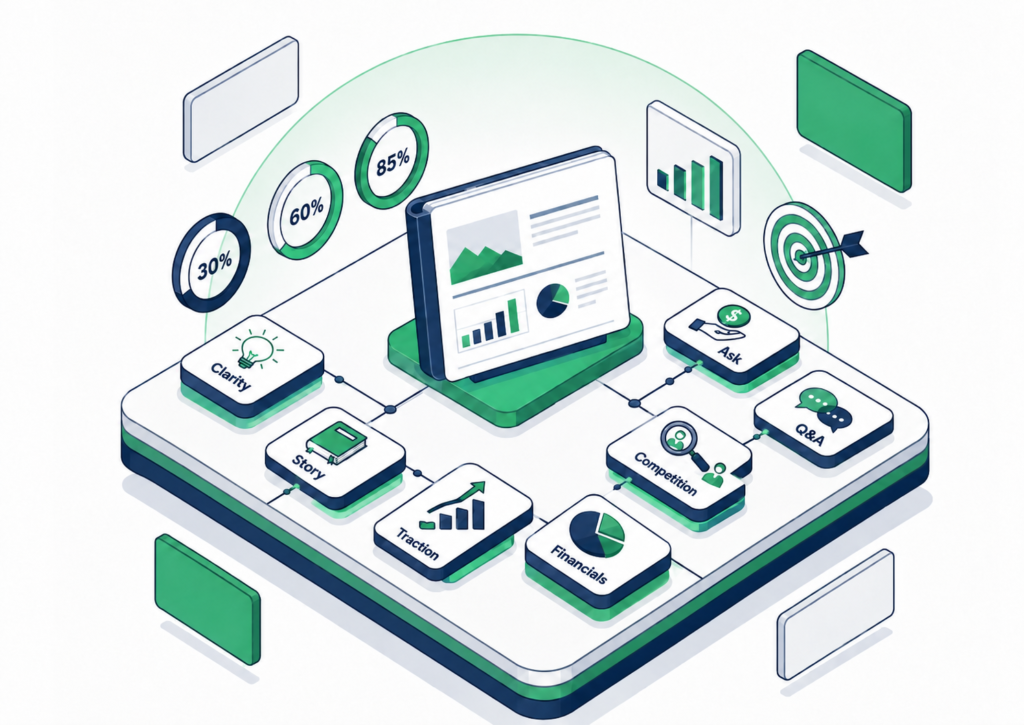
Now you are looking at a pitch deck you have already edited countless times and asking:
Is this actually ready to present?
Many founders spend the final hours changing colours, moving icons, or adding more information. Those details matter, but investors are usually asking more fundamental questions:
- Do I understand the company?
- Is the problem important?
- Is there evidence that customers care?
- Can this become a large business?
- Do the numbers make sense?
- Why is this team likely to win?
- What will my investment help the company achieve?
Your pitch deck does not need to answer every possible question. Its job is to make the opportunity clear, credible, and interesting enough to continue the conversation.
This founder checklist will help you review the story, slides, financials, and fundraising ask before your investor meeting.
Table of Contents
| Section | What You Will Review |
|---|---|
| 1 | The five-minute clarity test |
| 2 | The overall investment story |
| 3 | The opening and company description |
| 4 | The problem slide |
| 5 | The solution and product slides |
| 6 | The market opportunity |
| 7 | The business model |
| 8 | Traction and customer evidence |
| 9 | Go-to-market strategy |
| 10 | Competition and differentiation |
| 11 | The founding team |
| 12 | Financial projections |
| 13 | The fundraising ask |
| 14 | Slide design and readability |
| 15 | Investor questions and appendix |
| 16 | The final presentation rehearsal |
1. Start With the Five-Minute Clarity Test
Open your deck and review it as though you know nothing about the company.
Do not explain the slides to yourself. Read only what is visible.
After five minutes, a new reader should understand:
- What your company does
- Who your customer is
- What problem you solve
- How you make money
- What progress you have made
- Why the opportunity could become large
- How much you are raising
Then close the deck and describe the company in one sentence.
Too vague
We are building an intelligent ecosystem that transforms business operations.
The sentence sounds polished, but the investor still does not know what the company sells.
Clearer
We help independent retailers predict demand and reduce unsold inventory using automated forecasting software.
The second version gives the investor a customer, problem, product, and benefit.
Another example
Too technical:
Our proprietary multimodal architecture automates knowledge-intensive enterprise workflows.
Clearer:
We help legal teams search internal documents and prepare case summaries using secure AI software.
A strong pitch deck makes the business easier to understand—not more impressive-sounding.
2. Review the Deck as One Story
A pitch deck is not a collection of company facts.
It should guide the investor through a logical investment story:
A meaningful problem exists.
Current alternatives are inadequate.
We have created a better solution.
Customers are showing that they want it.
The opportunity can become large.
Our team is positioned to execute.
We are raising capital to reach the next major milestone.
Read only the headlines of your slides from beginning to end.
Do they tell a coherent story?
Weak headline sequence
- About Us
- Technology
- Market
- Team
- Product Features
- Financials
- Problem
- Contact Us
The investor has to assemble the story independently.
Stronger headline sequence
- Independent clinics lose hours every week to fragmented administrative systems
- Our platform automates scheduling, follow-ups, and insurance verification
- Forty-two clinics are already using the product
- A focused initial market creates a path into a much larger healthcare opportunity
- Recurring subscriptions generate predictable revenue
- Our acquisition channel is becoming repeatable
- Our team has built and sold software to this customer group
- We are raising $1.6 million to reach the next commercial milestone
The second sequence already communicates the investment case before the investor reads the smaller text.
3. Make the Opening Immediately Understandable
Your opening slides set the direction for the entire meeting.
The cover slide should usually include:
- Company name
- A clear one-line description
- Founder contact information
- Optional supporting visual
Avoid using only a brand slogan.
Weak cover line
Building the future of connected commerce.
Stronger cover line
Inventory-planning software for independent grocery retailers.
A slogan can support the company description, but it should not replace it.
Strong opening example
Stockwise
Helping independent grocery retailers reduce stockouts and unsold inventory.
The investor immediately understands the category and customer benefit.
Your next few slides should quickly establish:
- The problem
- The customer
- Your solution
- Why the timing is attractive
Do not make the investor wait until slide seven to discover what the company actually does.
4. Make the Problem Specific and Expensive
Many problem slides describe an inconvenience rather than a serious business problem.
Weak problem statement
Managing employee schedules is difficult.
Stronger problem statement
Multi-location restaurants spend more than 15 hours per week manually coordinating staff availability, shift changes, and overtime across separate spreadsheets and messaging apps.
The stronger version explains:
- Who experiences the problem
- What causes it
- How frequently it occurs
- What it costs the customer
Your problem slide may use:
- Customer interviews
- Workflow examples
- Existing spending
- Lost revenue
- Time wasted
- Compliance exposure
- Operational delays
- Customer complaints
Example for a fintech startup
Weak:
Small businesses struggle with cash flow.
Stronger:
Wholesale businesses often wait 45–75 days for customer payments while supplier and payroll expenses must be paid immediately.
Example for a healthcare startup
Weak:
Clinic administration is inefficient.
Stronger:
Clinic teams manually confirm appointments, check insurance, and follow up with patients across multiple disconnected systems, increasing missed appointments and administrative costs.
The problem should feel important enough that customers will actively seek and pay for a solution.
5. Show How the Solution Changes the Customer’s Experience
Your solution slide should directly answer the problem slide.
Avoid listing every feature.
Feature-heavy version
- Automated notifications
- Analytics dashboard
- AI assistant
- Workflow management
- Custom reporting
- Integrations
- Team permissions
- Cloud storage
The investor sees functionality but may not understand the value.
Outcome-focused version
Our platform automatically confirms appointments, verifies insurance information, and follows up with patients—reducing administrative work from several hours to a few minutes per day.
Then show how the product delivers that outcome.
A useful product section may include:
- One clear product screenshot
- A simple three-step workflow
- A short demonstration
- Before-and-after comparison
- A customer example
Example workflow
- Customer data enters the platform
- The system identifies the required action
- The customer receives an automated result or recommendation
Keep the product explanation simple enough for a non-technical investor to understand.
Technical details can sit in the appendix.
6. Make the Market Opportunity Credible
A large global market figure is not enough.
Investors want to understand where you will begin and how you can expand.
Weak market argument
The global healthcare industry is worth trillions of dollars. Capturing 1% would create a billion-dollar company.
This does not explain how the startup reaches its first customer.
Stronger market argument
We are initially targeting 14,000 private clinics in Germany that use independent administrative systems. After building distribution through clinic groups and professional associations, we can expand into neighbouring European markets and larger healthcare networks.
A useful market slide explains:
- Your first target segment
- The number of potential customers
- Expected annual value per customer
- Geographic focus
- Expansion opportunities
Example
Suppose your initial market includes:
- 10,000 potential customers
- Average annual contract value of $8,000
Your initial serviceable opportunity is approximately $80 million annually.
You may then explain how the company expands through:
- Larger customers
- Additional products
- New geographies
- Higher pricing tiers
- Transaction revenue
- Partnerships
- Platform opportunities
The market story should connect a focused starting point with venture-scale potential.
7. Explain the Business Model in Practical Terms
Your business-model slide should make it easy to understand how revenue is generated.
Weak version
We operate a flexible, scalable, multi-channel monetisation model.
Clearer version
Customers pay between $400 and $1,200 per month, depending on the number of locations and users.
Include the main revenue drivers:
- Pricing
- Contract length
- Average contract value
- Gross margin
- Recurring versus one-time revenue
- Transaction fees
- Expansion opportunities
SaaS example
Clinics pay an annual subscription based on the number of practitioners. The current average contract value is $9,600 per year.
Marketplace example
We charge suppliers an 8% commission on completed transactions and offer premium placement through a monthly subscription.
Consumer-product example
We sell directly through our website at a 62% gross margin and through retailers at a 38% wholesale margin.
Investors should be able to connect customers, pricing, and revenue without searching through the financial model.
8. Turn the Traction Slide Into Evidence
Traction should show that the company is reducing uncertainty.
A slide containing several disconnected numbers can look impressive but remain unclear.
Weak traction slide
- 18,000 users
- 46% growth
- 12 partnerships
- Six markets
- 500,000 transactions
The investor may ask:
- Over what period?
- Are the users active?
- Are they paying?
- Do the partnerships generate revenue?
- Is the growth continuing?
Stronger traction examples
Monthly recurring revenue increased from $11,000 to $43,000 over the past 12 months.
Sixty-nine percent of paid pilots converted into annual contracts.
Active customers grew from 22 to 91 while monthly churn declined from 5.8% to 2.7%.
Our accounting-firm partnership now generates 35% of qualified sales opportunities.
Pre-revenue example
We completed 68 customer interviews, secured six design partners, and have four companies testing the working product every week.
Consumer example
The beta generated 9,000 registrations in three months, with 38% of users returning weekly and 21% inviting another user.
Deep-tech example
The prototype reduced inspection time by 47%, and two industrial customers have signed paid feasibility agreements.
Choose the metrics that best demonstrate progress at your stage.
Do not present:
- Registered users as active users
- Non-binding interest as contracted revenue
- Conversations as partnerships
- Gross transaction volume as company revenue
- Free users as paying customers
Precise language builds credibility.
9. Show How Customer Acquisition Actually Works
“We will use social media and partnerships” is not a go-to-market strategy.
Investors want to understand:
- Who makes the buying decision
- How you reach them
- How long the sales process takes
- What the acquisition process costs
- Which channels have been tested
- How the process can scale
Weak example
We will grow through digital marketing, direct sales, and strategic partnerships.
Stronger example
Our first 34 customers came through regional accounting firms. Each partner introduces approximately 12 qualified businesses per quarter, and 19% currently convert into paid customers.
Enterprise sales example
The average sales cycle is 75 days. Each salesperson manages approximately 25 qualified opportunities per quarter, with a 16% close rate and an average first-year contract value of $32,000.
Product-led example
Free users invite an average of 2.1 team members. Twelve percent of active teams convert to the paid plan within 45 days.
You do not need a perfectly optimised go-to-market engine at pre-seed.
You do need to show that you are learning how customers discover, evaluate, and purchase the product.
10. Be Realistic About Competition
“We have no competitors” is rarely convincing.
Customers are already solving the problem through:
- Spreadsheets
- Internal employees
- Consultants
- Agencies
- Legacy software
- General-purpose platforms
- Doing nothing
These are all alternatives.
Weak comparison
A table where your company has eight green check marks and every competitor has only red crosses.
Better comparison
Focus on three or four factors customers genuinely care about.
| Option | Implementation | Specialisation | Price | Automation |
|---|---|---|---|---|
| Spreadsheets | Immediate | Low | Low | Low |
| Legacy software | Slow | Medium | High | Medium |
| Your startup | Fast | High | Medium | High |
Then explain why your advantage can last.
Example
Competitors provide general inventory software. Our advantage is a forecasting model trained specifically for perishable products, direct integration with supplier ordering systems, and distribution through industry associations.
A strong competition slide shows that you understand the market, not that you are trying to pretend competition does not exist.
11. Make the Team Slide Relevant to the Business
A team slide should answer:
Why is this team unusually well positioned to build this company?
Generic version
Our founders have 30 years of combined experience and have worked at leading companies.
Stronger version
Our CEO previously managed inventory across 300 retail locations. Our CTO built forecasting systems for two national grocery chains. Our commercial lead sold software to the same customer group for seven years.
The stronger version connects experience to execution.
Highlight:
- Industry knowledge
- Technical expertise
- Customer relationships
- Previous startup experience
- Relevant operating experience
- Regulatory knowledge
- Complementary founder skills
Avoid filling the slide with unrelated awards, courses, or company logos that do not strengthen the investment case.
When an important capability is missing, acknowledge it and show the hiring plan.
For example:
We plan to hire an experienced enterprise sales leader after the round, with recruitment beginning in month three.
12. Make Sure the Financial Model Supports the Deck
Your deck and financial model should present the same business.
Check that the following numbers match:
- Historical revenue
- Customer count
- Pricing
- Growth rates
- Gross margin
- Monthly burn
- Hiring plan
- Runway
- Fundraising amount
- Use of funds
- Forecast milestones
Example of inconsistency
The deck says:
The round provides 20 months of runway.
The financial model shows:
- Starting cash: $1.5 million
- Average monthly burn: $95,000
- Rapid hiring beginning in month four
The company may have considerably less than 20 months once hiring and operating growth are included.
Example of unsupported growth
The forecast shows revenue growing from $600,000 to $5 million, but the model includes:
- No additional salespeople
- No marketing increase
- No customer-support hiring
- No infrastructure expansion
The forecast may look attractive, but the operating plan does not support it.
A stronger financial model connects:
Customers → pricing → revenue → staffing → costs → burn → runway.
You should be able to explain the major assumptions in plain language.
13. Connect the Fundraising Ask to Milestones
Do not end with:
We are looking for investment to scale the business.
Be specific.
Your fundraising slide should explain:
- Amount being raised
- Funding stage
- Expected runway
- Main use of capital
- Milestones to be reached
- Position before the next round
Weak ask
We are raising $2 million for product, marketing, and hiring.
Stronger ask
We are raising $2 million to complete the enterprise product, hire four commercial team members, and grow from $550,000 to $2.2 million ARR over approximately 18 months.
Pre-seed example
We are raising $750,000 to complete the commercial product, convert five design partners, and reach the first 20 paying customers.
Consumer-product example
We are raising $1.3 million to increase production capacity, launch with two national retailers, and reach $3 million in annual sales.
Investors want to understand what becomes true after the funding has been used.
14. Give Every Slide One Main Message
A slide should not require the investor to choose which information matters.
Ask:
What is the one thing I want the investor to remember?
Turn that into the headline.
Weak headline
Traction
Stronger headline
Revenue grew 3.6× over the past 12 months
Weak headline
Market Opportunity
Stronger headline
Our initial segment includes 18,000 businesses spending $9,000 annually
Weak headline
Go-to-Market
Stronger headline
Accounting partners generate one-third of qualified opportunities
The headline gives the conclusion. The chart or visual underneath proves it.
Remove information that does not support the conclusion.
15. Prepare an Appendix for Deeper Questions
Your main pitch deck should be concise, but the appendix can contain the details investors may request.
Useful appendix slides may cover:
- Financial assumptions
- Customer cohorts
- Retention
- Unit economics
- Product roadmap
- Technical architecture
- Market calculations
- Pricing
- Sales pipeline
- Regulatory strategy
- Cap table
- Hiring plan
- Competitor details
- Use of funds
Example
Your main traction slide may show:
$720,000 ARR with 94% gross revenue retention.
The appendix can show:
- Revenue by customer
- Churn by cohort
- Expansion revenue
- Contract duration
- Customer concentration
- Monthly development
The main deck starts the conversation. The appendix helps you answer it.
16. Practise the Meeting, Not Just the Slides
Present the deck aloud before the meeting.
This will reveal:
- Slides that take too long to explain
- Repeated information
- Awkward transitions
- Unsupported claims
- Difficult financial assumptions
- Sections where the story loses momentum
Do not memorise every sentence.
Know:
- The central message of each slide
- The evidence supporting it
- The most likely investor question
- The transition to the next slide
Investors may interrupt after three slides and spend the rest of the meeting discussing retention or customer acquisition.
That is normal.
Your deck is a conversation tool, not a script that must be completed in order.
Questions Your Pitch Deck Should Prepare You to Answer
| Topic | Likely Investor Question |
|---|---|
| Problem | How are customers solving this today? |
| Product | Why is your solution meaningfully better? |
| Traction | Is the growth repeatable? |
| Revenue | What drives the forecast? |
| Retention | Why do customers stay or leave? |
| Market | Why can this become venture-scale? |
| Competition | What prevents others from copying you? |
| Go-to-Market | How much does it cost to acquire a customer? |
| Team | Which key capability is still missing? |
| Financials | What happens when growth is slower than expected? |
| Fundraising | Why do you need this exact amount? |
| Valuation | What supports your valuation expectation? |
Identify the questions you least want to receive.
Those are usually the questions you most need to prepare for.
Final Pitch Deck Review Checklist
| Review Area | Final Question |
|---|---|
| Opening | Can a new reader quickly understand the company? |
| Problem | Is the customer pain specific and important? |
| Solution | Is the customer benefit clearer than the feature list? |
| Story | Does every slide lead naturally to the next? |
| Market | Is there a credible starting segment and expansion path? |
| Business Model | Are pricing and revenue drivers easy to understand? |
| Traction | Are metrics accurate, contextual, and stage-appropriate? |
| Go-to-Market | Is there evidence of how customers are acquired? |
| Competition | Are real alternatives acknowledged? |
| Team | Is founder-market fit clearly demonstrated? |
| Financials | Do the deck and financial model match? |
| Ask | Are the amount, runway, and milestones specific? |
| Design | Does each slide communicate one main idea? |
| Appendix | Are detailed answers ready when requested? |
| Delivery | Have you practised the meeting aloud? |
| File Check | Does the deck open correctly on another device? |
Your Pitch Deck Is Only One Part of Fundraising
A strong pitch deck can create investor interest, but it cannot compensate for an inconsistent financial model, unrealistic fundraising ask, or poorly targeted investor list.
Your deck, model, data room, investor targeting, and outreach message should present one consistent investment case.
At GetPitchRaise, we support early-stage founders through three stages:
1. Pitch Deck and Financial Model Assessment
We review your existing materials to identify unclear messaging, inconsistent figures, unsupported assumptions, and questions investors may raise.
2. Fundraising Material Development
We help develop investor-ready materials that communicate the opportunity clearly and support one consistent fundraising story.
3. Investor Outreach
We research relevant investors and support structured outreach based on your stage, sector, geography, check size, and fundraising objectives.
Is Your Pitch Deck Ready for Investors?
Book a free consultation call now to review your fundraising materials and prepare for investor outreach.