One of the first decisions founders face when fundraising is not simply how much to raise, but how to raise it.
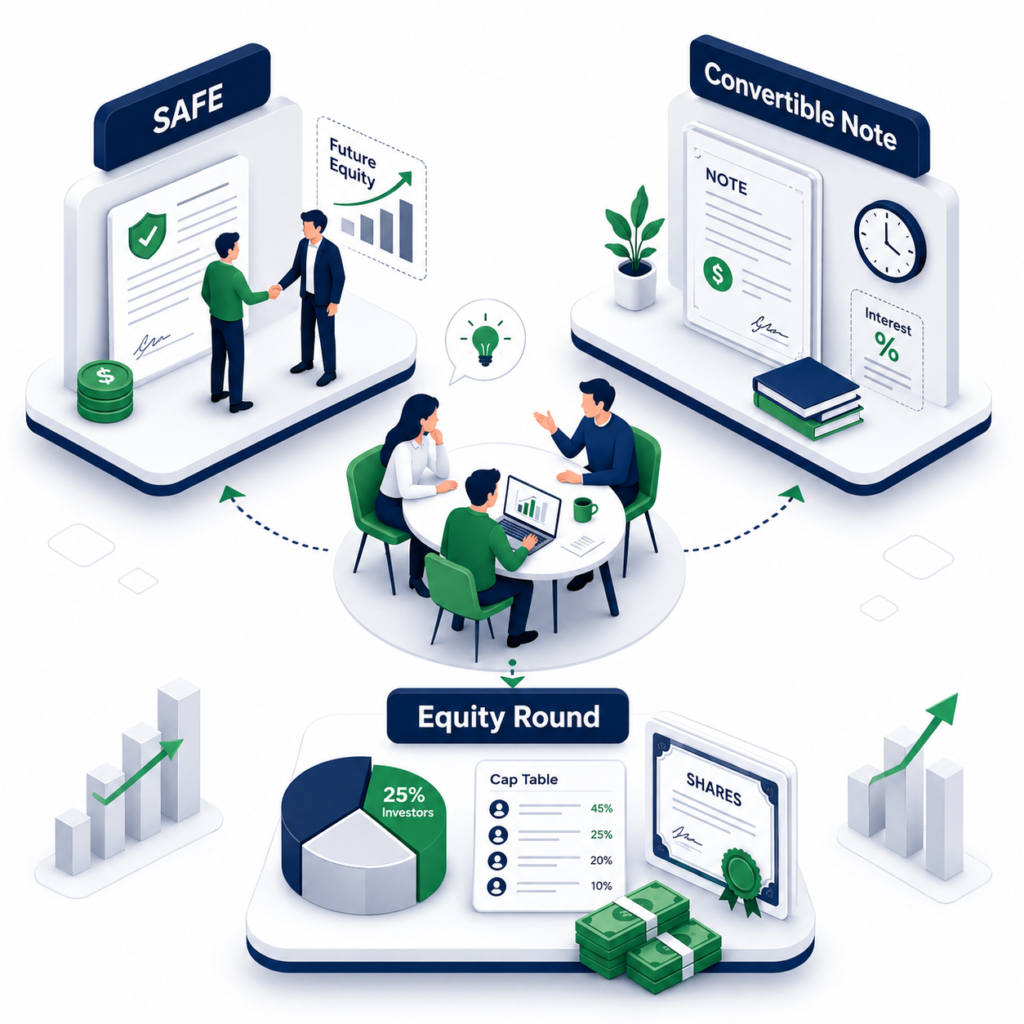
Should investors put money in through a SAFE, a convertible note, or a priced equity round?
All three can fund a startup, but they work differently.
A SAFE generally postpones the share-price calculation until a later financing. A convertible note also converts later, but starts as debt and typically includes interest and a maturity date. A priced equity round sets the company valuation and investor ownership when the investment is made.
The best option depends on your stage, round size, investor expectations, jurisdiction, and how much complexity you want to introduce.
1. The Quick Comparison
| SAFE | Convertible Note | Priced Equity Round | |
|---|---|---|---|
| What is it? | Agreement for future equity | Debt that can convert into equity | Investors purchase shares now |
| Valuation fixed now? | Usually not a full priced valuation; often uses a valuation cap | Usually deferred, often with a cap and/or discount | Yes |
| Investor becomes shareholder immediately? | Generally no | Generally no, until conversion | Yes |
| Interest | No | Usually yes | No |
| Maturity date | Generally no | Usually yes | No |
| Typical complexity | Low | Medium | High |
| Speed to close | Usually fastest | Relatively fast | Usually slower |
| Legal documentation | Relatively light | More than a SAFE | Significantly more extensive |
| Governance rights immediately | Usually limited | Usually limited before conversion | Often negotiated as part of the round |
| Dilution | Happens when SAFE converts; post-money SAFEs can make ownership sold easier to estimate | Determined when note converts | Visible at closing |
| Common use | Pre-seed and seed | Early rounds and bridge financing | Larger seed, Series A and later institutional rounds |
Y Combinator’s current SAFE documents use a post-money SAFE structure. YC says this makes it possible for founders and investors to calculate more precisely how much ownership has been sold through the SAFE financing.
2. What Is a SAFE?
SAFE stands for Simple Agreement for Future Equity.
The investor gives your startup money now. Instead of receiving shares immediately, the SAFE normally converts into shares after a future triggering event, commonly a priced financing.
Unlike a traditional convertible note, a SAFE generally does not have an interest rate or maturity date. This is one reason it can be simpler to negotiate and administer.
A SAFE may contain a:
Valuation cap, which establishes a maximum valuation used for calculating conversion.
Discount, which may allow the investor to convert at a lower share price than new investors.
MFN provision, which can give an investor certain benefits if more favourable SAFE terms are later issued.
Pro rata right, when separately provided, which may allow the investor to maintain its ownership in a future financing.
YC currently publishes US post-money SAFE forms including valuation-cap, discount-only, and uncapped MFN versions, as well as a separate pro rata side letter. It also publishes jurisdiction-specific versions for certain non-US companies.
3. A Simple SAFE Example
Suppose your startup raises:
$500,000 on a $5 million post-money SAFE cap.
In a simplified scenario where the cap determines conversion, that SAFE represents approximately:
$500K ÷ $5M = 10%
That makes it easier to understand the approximate ownership you are selling through that SAFE.
But imagine you keep raising:
| SAFE Investor | Investment | Post-Money Cap |
|---|---|---|
| Investor A | $500K | $5M |
| Investor B | $500K | $5M |
| Investor C | $500K | $5M |
Founders sometimes think:
“We haven’t completed a priced round yet, so we haven’t really diluted.”
That is dangerous thinking.
You have raised $1.5 million through securities that can convert into equity. The resulting ownership impact needs to be modelled before signing each additional SAFE.
A SAFE is simple legally. Its cap-table consequences are not automatically simple.
4. When Does a SAFE Make Sense?
A SAFE can be particularly useful when a company is early and wants to raise relatively quickly without negotiating a full priced financing.
For example, a pre-seed company has:
A working product
Four design partners
Early customer validation
$300K available from several angels
Trying to negotiate a full preferred-equity round for each small angel investment may create unnecessary cost and complexity.
A SAFE may allow the company to raise the capital, continue building, and postpone a more comprehensive priced financing until it has stronger evidence.
This is one reason SAFEs became widely used for early-stage fundraising. YC describes the SAFE as a streamlined instrument designed to let startups raise money more easily before a priced financing.
5. What Is a Convertible Note?
A convertible note also allows a startup to receive money before completing a priced equity round.
But there is an important difference:
A convertible note is debt.
The investor lends money to the company, and the note is generally expected to convert into equity when specified conditions are met.
Typical note terms include principal, interest, maturity date, conversion mechanics, a valuation cap, and sometimes a discount.
For example:
Investment: $500K
Interest: 6%
Maturity: 18 months
Valuation cap: $6M
Discount: 20%
If the company later raises a qualified equity round, the note may convert according to the terms giving the note investor the applicable conversion economics.
Because the instrument is debt before conversion, founders also need to understand what happens if the next financing has not occurred by maturity.
6. SAFE vs Convertible Note
The two instruments may look similar because both can postpone a full priced financing.
The important differences are:
| Question | SAFE | Convertible Note |
|---|---|---|
| Is it debt? | Generally no | Yes |
| Does interest usually accrue? | No | Yes |
| Is there usually a maturity date? | No | Yes |
| Can it have a valuation cap? | Yes | Yes |
| Can it include a discount? | Depending on form | Commonly |
| Does it normally convert later? | Yes | Yes |
| Founder pressure from maturity? | Lower | Higher |
| Documentation | Usually simpler | Usually more detailed |
Cooley notes that convertible debt continues to be used for initial fundraising and bridge financings, while SAFEs provide a related but distinct early-stage financing alternative.
7. When Might a Convertible Note Make More Sense?
A note may be useful when the investor wants the protections associated with debt or when the company expects a clearly defined financing event relatively soon.
Consider a startup that already has institutional investors and expects to raise Series A within six months.
It needs another $750K to extend runway and reach the round.
The existing investors may provide a convertible note as a bridge financing.
That can make sense because both sides expect a priced round relatively soon.
But maturity matters.
If the expected Series A does not happen, the company could reach the note’s maturity date while still needing capital.
That is why founders should understand the maturity and repayment provisions rather than viewing the note simply as “a SAFE with interest.”
8. What Is a Priced Equity Round?
A priced equity round works differently.
The company and investors agree on the company’s valuation and investors purchase shares at an established price.
Suppose your startup raises:
$2 million at an $8 million pre-money valuation.
The post-money valuation becomes:
$8M + $2M = $10M
Ignoring other dilution adjustments for this simple example, the new investors collectively own:
$2M ÷ $10M = 20%
Unlike a SAFE or note, the ownership created by the new investment is established as part of the closing.
The round will normally involve considerably more negotiation and documentation.
In US venture financings, for example, the NVCA’s current model-document set includes a stock purchase agreement, investors’ rights agreement, voting agreement, certificate of incorporation, and right-of-first-refusal/co-sale agreement. The NVCA updated these model documents again in October 2025 to reflect evolving market norms and legal developments.
9. Why Is a Priced Round More Complicated?
Because you are negotiating more than the investment amount.
A priced round may involve decisions about:
| Term | What It Affects |
|---|---|
| Pre-money valuation | Price paid by the investor |
| Investor ownership | Founder and existing shareholder dilution |
| Liquidation preference | Distribution of proceeds in an exit |
| Board seats | Company governance |
| Voting rights | Investor influence over major decisions |
| Protective provisions | Actions requiring investor approval |
| Option pool | Employee equity and founder dilution |
| Pro rata rights | Future investor participation |
| Information rights | Financial and company reporting |
| Anti-dilution provisions | Treatment of future lower-priced financing |
This is why founders should compare the entire term sheet rather than focusing exclusively on valuation.
You can internally link this section to:
Mastering Startup Term Sheet Negotiations: A Practical Founder’s Guide
10. When Does a Priced Equity Round Make Sense?
A priced round becomes more attractive when the financing is larger, an institutional lead investor is involved, and both sides want the ownership and governance structure clearly established.
For example:
A seed-stage SaaS startup has:
$700K ARR
Strong retention
90 customers
A repeatable sales channel
A lead VC willing to invest $2M of a $3M round
A priced equity round may make more sense than collecting $3 million through many separate SAFEs.
The company can establish:
- A clear valuation
- Investor ownership
- Board structure
- Employee option pool
- Investor rights
- Governance rules
- Future financing framework
The additional work may be justified by the size and importance of the round.
11. Which Instrument Is Usually Better by Stage?
There is no universal rule, but this framework can help.
| Situation | Often Worth Considering |
|---|---|
| Very early pre-seed raise | SAFE |
| Several small angel investments | SAFE |
| Need capital quickly while still validating | SAFE |
| Bridge to an expected priced round | Convertible Note or SAFE |
| Investor specifically requires debt structure | Convertible Note |
| Significant institutional seed round | SAFE or Priced Equity, depending on the deal |
| Lead VC establishing governance rights | Priced Equity |
| Series A institutional financing | Priced Equity |
| Complex ownership or major institutional round | Priced Equity |
This is a decision framework, not a legal rule. Market practice differs by country, investor, stage, and company structure.
12. Do Not Choose a SAFE Just Because It Is Faster
One of the biggest SAFE mistakes is repeatedly raising without modelling dilution.
Imagine a founder raises:
$400K here
$300K three months later
$600K six months later
another $500K before Series A
Each cheque feels manageable.
Together, however, they may represent a meaningful portion of the company.
Before signing a SAFE, model:
Current ownership → SAFE conversion → option-pool changes → new priced-round dilution → founder ownership after financing.
Your cap table should show the combined effect of every outstanding security.
For more detail, link to:
Building a Strong Cap Table: A Guide to Your Startup’s Ownership Structure
13. Do Not Choose a Note Without Thinking About Maturity
A convertible note may feel easy when it is signed.
The important question is what happens later.
Suppose the note matures in 18 months and your expected financing is delayed.
What happens?
Does the investor:
- Extend the note?
- Convert it?
- Demand repayment?
- Renegotiate the terms?
The answer depends on the agreement.
Founders should understand this before accepting the investment, particularly when their cash forecast already assumes another fundraising round.
14. Do Not Choose a Priced Round Only Because the Valuation Looks Better
A high headline valuation can hide less attractive terms.
Compare:
| Offer A | Offer B | |
|---|---|---|
| Pre-money valuation | $12M | $10M |
| Investment | $3M | $3M |
| Option-pool increase | 12% | 6% |
| Liquidation preference | More investor-favorable | Standard 1x non-participating |
| Board | Investor-heavy | Balanced |
| Founder re-vesting | Significant | Limited |
Offer A has the higher headline valuation.
That does not automatically make it the better deal.
Model dilution, control, exit outcomes, and future financing flexibility before deciding.
15. What Should Founders Compare Before Choosing?
Use this final comparison.
| Question | SAFE | Convertible Note | Equity Round |
|---|---|---|---|
| Need to close quickly? | Strong fit | Strong fit | Less ideal |
| Want minimum documentation? | Strongest | Moderate | Weakest |
| Want to defer a full valuation negotiation? | Yes | Yes | No |
| Want no maturity date? | Usually yes | No | Yes |
| Want no interest accrual? | Yes | No | Yes |
| Want ownership established immediately? | No | No | Yes |
| Raising many small early checks? | Often suitable | Possible | Less efficient |
| Raising a large institutional round? | Possible | Less common as primary structure | Often suitable |
| Investor wants governance rights now? | Less suitable | Less suitable | Strongest |
| Need a bridge financing? | Possible | Common use | Possible but heavier |
The Simplest Decision Framework
If you are very early and need a fast, relatively simple financing, a SAFE may be worth considering.
If you are raising bridge capital and investors want a debt instrument with a defined maturity, a convertible note may fit better.
If you are raising a significant institutional round and are ready to establish valuation, ownership, and governance, a priced equity round may be the more appropriate structure.
But the financing instrument should follow the fundraising strategy—not the other way around.
Before choosing, understand:
How much you need, what milestone the money will achieve, how much dilution it creates, what rights investors receive, and what your cap table will look like afterward.
Your financial model can help establish the appropriate round size and runway, while your cap table shows the ownership consequences.
You can internally link here to:
Financial Model Check: Will Your Numbers Hold Up in an Investor Meeting?
and
Startup Fundraising Timeline: What to Do 12 Months Before You Raise
SAFE, Note, or Equity: Know the Economics Before You Sign
There is no financing instrument that is automatically best for every startup.
A SAFE may offer speed and simplicity. A convertible note may work well for certain early-stage or bridge financings. A priced equity round can provide greater clarity when a larger institutional investment is being completed.
What matters is understanding what happens after the money enters the bank account.
At GetPitchRaise, we support early-stage founders through:
- Pitch Deck and Financial Model Assessment
- Fundraising Material Development
- Investor Outreach
Preparing Your Next Funding Round?
Book a free consultation call now to review your fundraising materials and prepare for investor outreach.