Fundraising becomes difficult to manage once investor conversations start multiplying.
One investor requests the deck. Another asks for an introduction to a partner. A third wants updated traction figures. Several have not replied, and one promising conversation has been waiting for a follow-up for ten days.
Without a clear system, founders lose momentum—not because investors are uninterested, but because important actions are missed.
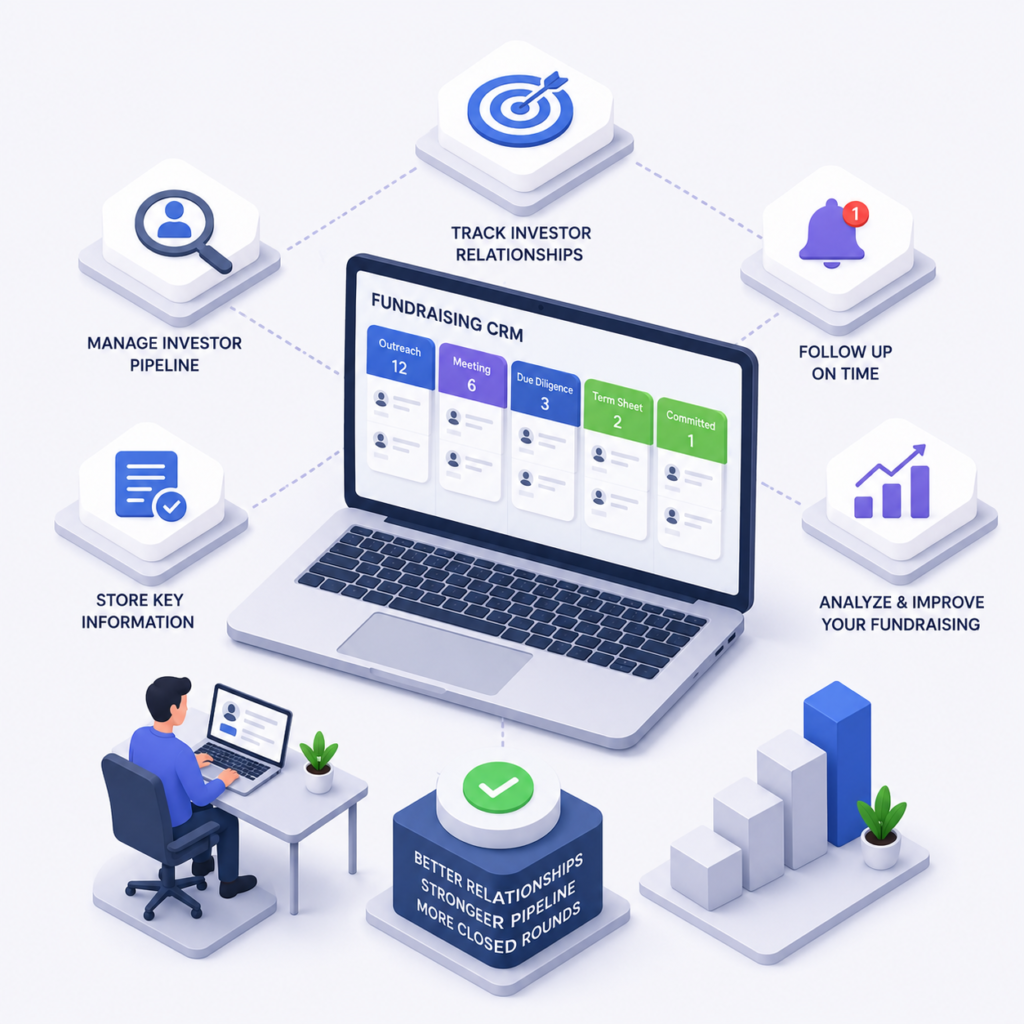
A fundraising CRM helps you organise investor research, outreach, meetings, follow-ups, diligence, and commitments in one place. It can be built in a dedicated CRM platform or a well-structured spreadsheet. The tool matters less than the process behind it.
1. Start With a Clear Investor Pipeline
Your CRM should show where every investor currently sits in the fundraising process.
A practical pipeline may include:
| Stage | Meaning |
|---|---|
| Researching | Investor appears relevant but still needs verification |
| Ready for Outreach | Contact and personalisation are prepared |
| Contacted | Initial message has been sent |
| Replied | Investor responded but no meeting is booked |
| First Meeting | Introductory meeting scheduled or completed |
| Partner Meeting | Opportunity is being reviewed more seriously |
| Due Diligence | Investor is reviewing detailed information |
| Term Sheet | Investment terms are being discussed |
| Committed | Investor has confirmed participation |
| Passed | Investor declined or is no longer progressing |
| Follow Up Later | Relevant investor, but timing is not right |
Use clear definitions so every investor is placed consistently.
For example, an investor who says, “Send me an update in three months,” should not remain under “Replied.” Move them to “Follow Up Later” and schedule the next action.
2. Record More Than Names and Email Addresses
A useful fundraising CRM should explain why each investor belongs in your campaign.
Include:
| Field | Why It Matters |
|---|---|
| Investor name | Identifies the individual decision-maker |
| Firm | Connects the contact to the fund |
| Role | Shows whether they can lead or influence the decision |
| Email and LinkedIn | Supports outreach and research |
| Stage focus | Confirms pre-seed, seed, or Series A fit |
| Sector and subsector | Shows investment relevance |
| Geography | Confirms regional eligibility |
| Typical check size | Helps determine whether the investor fits the round |
| Relevant portfolio companies | Supports personalisation and reveals conflicts |
| Recent investment activity | Indicates whether the investor is actively deploying capital |
| Lead or follower | Helps you structure the round |
| Priority | Focuses attention on the strongest targets |
| Current status | Shows where the relationship stands |
| Next action | Prevents missed follow-ups |
| Next action date | Creates accountability |
| Notes | Records feedback, objections, and context |
Avoid filling the CRM with investors who technically exist but have no clear relevance to your company.
A smaller, well-researched pipeline is easier to manage and usually produces better conversations.
3. Prioritise Investors by Fit
Not every investor deserves the same level of attention.
Create three priority groups.
Priority A: Strong Fit
These investors match your stage, sector, geography, check size, and business model. They are active and have relevant portfolio experience.
Their outreach should be highly personalised.
Priority B: Good Fit
They match most criteria, but one area needs confirmation. Perhaps the geography is broader than usual or the check size is slightly outside your target.
Priority C: Possible Fit
They have some relevance but weaker evidence of alignment. Contact them after testing your message with stronger targets.
You can also use a simple score.
| Criterion | Score |
|---|---|
| Stage match | 0–2 |
| Sector match | 0–2 |
| Geography match | 0–2 |
| Check-size match | 0–2 |
| Recent activity | 0–2 |
| Relevant portfolio | 0–2 |
| Warm introduction available | 0–2 |
The score should support judgment, not replace it.
An investor with a high score may still be unsuitable because of a direct portfolio conflict or a recent change in strategy.
4. Give Every Investor One Next Action
The most important field in your CRM is not the investor’s name.
It is the next action.
Every active investor should have:
- A specific action
- A responsible person
- A due date
Examples include:
Send personalised introduction by Thursday.
Follow up with updated revenue figures on 18 September.
Ask existing investor for an introduction.
Share financial model after partner meeting.
Prepare customer retention analysis before diligence call.
Avoid vague actions such as:
Follow up sometime next week.
A useful CRM should make it immediately clear what needs to happen today.
5. Build a Consistent Follow-Up Process
Many investor conversations disappear because founders stop following up too early or continue following up without adding value.
A practical sequence may look like this:
| Timing | Follow-Up |
|---|---|
| Day 0 | Initial outreach |
| Day 4–6 | Short reminder |
| Day 10–14 | Follow-up with a useful update or clearer investor-fit point |
| Final follow-up | Respectfully close the loop |
| Later date | Reconnect only when there is meaningful progress |
First follow-up example
Hi Sarah,
Following up in case my earlier note was missed. We help regional freight operators reduce empty journeys and currently generate $46K MRR.
Would this fit your current seed investment focus?
Progress-based follow-up example
Hi Sarah,
A quick update since my previous email: we signed two additional enterprise customers and increased MRR to $52K.
We are continuing to raise our $1.6M seed round and believe the company may fit your logistics-software focus.
Record every follow-up in the CRM. This prevents duplicate messages and helps you see which communication produced the response.
6. Track Investor Feedback
Investor feedback becomes valuable when patterns are visible.
Create fields for:
- Main concern
- Reason for passing
- Requested information
- Valuation feedback
- Product concerns
- Market concerns
- Traction concerns
- Timing concerns
- Investor-fit issues
For example, one investor saying your market is too small may reflect their individual strategy.
If six relevant investors raise the same concern, your market story may need improvement.
A simple feedback table can help:
| Feedback Type | Example | Action |
|---|---|---|
| Investor mismatch | Fund only invests at Series B | Remove from active pipeline |
| Timing issue | Fundraising pause until next quarter | Schedule future follow-up |
| Material weakness | Retention data is unclear | Improve analysis and materials |
| Repeated objection | Round size appears too large | Review fundraising plan |
| Portfolio conflict | Investor backs a direct competitor | Restrict information and deprioritise |
Do not rebuild your company after every meeting. Use the CRM to identify repeated themes.
7. Connect the CRM to Your Fundraising Materials
Your CRM should record which materials each investor has received.
Track:
- Pitch deck version
- Financial model version
- Executive summary
- Product demo
- Data-room access
- Customer information
- Cap-table summary
- Follow-up presentation
- Term sheet
This prevents investors from receiving outdated or inconsistent materials.
For example, if one investor received a deck showing $38K MRR and another received a later version showing $46K MRR, your CRM should record the difference.
When you send an update, explain what changed rather than silently replacing the document.
8. Control Data Room Access
Add data-room tracking to your CRM.
Useful fields include:
| Field | Purpose |
|---|---|
| Access granted | Confirms whether the investor can enter |
| Access date | Shows when diligence began |
| Access level | Deck only, limited diligence, or full diligence |
| Documents requested | Identifies current investor questions |
| Last activity | Helps assess whether interest is active |
| Access revoked | Protects information after a pass |
Do not automatically give every contacted investor full access.
A first-contact investor may only need the pitch deck. A serious lead may receive the financial model and selected commercial evidence. Full legal, ownership, customer, and employment records should usually be restricted to genuine diligence.
9. Track Warm Introductions Properly
Warm introductions are often lost because the founder does not track who offered to help, whether the introduction was sent, and what happened afterward.
Record:
- Name of the introducer
- Relationship to the investor
- Date requested
- Forwardable message sent
- Introduction completed
- Investor response
- Thank-you sent
Example request
We are raising a $1.4M seed round for our B2B logistics platform. I noticed you know Maria at Example Ventures, which invests in supply-chain software. Would you feel comfortable introducing us?
Once the introduction is made, thank the person promptly and update them when appropriate.
10. Create an Investor Update System
Not every suitable investor will invest immediately.
Some may want to follow the company before making a decision. Your CRM should help you maintain those relationships.
Track investors who ask for updates and note what they care about.
One investor may be waiting for:
- Stronger revenue growth
- A lead investor
- Product launch
- Improved retention
- Regulatory approval
- Expansion into a particular geography
Your periodic update can include:
| Area | Example |
|---|---|
| Growth | Revenue increased from $42K to $55K MRR |
| Customers | Five new annual contracts signed |
| Product | Enterprise version launched |
| Team | VP of Sales joined |
| Fundraising | First institutional commitment confirmed |
| Ask | Introductions to seed-stage fintech investors |
Keep updates short and factual.
The goal is to show progress, not send another full pitch every month.
11. Measure Your Fundraising Funnel
Your CRM should help you understand whether the campaign is working.
Track:
- Investors researched
- Investors contacted
- Reply rate
- Positive reply rate
- Meetings booked
- Partner meetings
- Due-diligence processes
- Term sheets
- Commitments
- Average response time
- Follow-up conversion
- Reasons for rejection
Example
Suppose you contact 100 investors and receive:
| Result | Number |
|---|---|
| Replies | 24 |
| Positive replies | 11 |
| First meetings | 8 |
| Partner meetings | 3 |
| Due-diligence processes | 2 |
| Commitments | 1 |
This tells you more than the overall reply rate.
A low reply rate may indicate poor investor targeting or weak messaging. Strong first-meeting conversion but no partner meetings may point to problems in the pitch, traction, market story, or fundraising ask.
12. Use Different Views for Different Decisions
One long spreadsheet can become difficult to manage.
Create filtered views for:
- Priority A investors
- Follow-ups due this week
- Investors awaiting information
- Investors in diligence
- Warm introductions
- Investors who passed
- Future follow-ups
- Potential lead investors
- Existing investors and commitments
A founder should be able to open the CRM and immediately answer:
Who needs attention today?
Which investors are closest to a decision?
Where is the round losing momentum?
How much capital is genuinely committed?
13. Keep Verbal Interest Separate From Commitments
Founders sometimes treat positive comments as investment commitments.
These are not the same.
Use clear categories:
| Status | Meaning |
|---|---|
| Interested | Investor wants to continue the discussion |
| Considering | Opportunity is under internal review |
| Verbal indication | Investor has mentioned a possible amount |
| Soft-circled | Investor has expressed serious intent, subject to conditions |
| Committed | Participation is clearly confirmed |
| Signed | Legal documents have been executed |
| Funded | Money has been received |
Do not report a round as nearly closed based only on polite investor interest.
Your CRM should reflect the real level of certainty.
14. Avoid These Fundraising CRM Mistakes
Common problems include:
| Mistake | Better Approach |
|---|---|
| Storing only names and emails | Record fit, activity, status, and next steps |
| Keeping investors in one long list | Use clear pipeline stages |
| Forgetting follow-ups | Give every active investor a dated action |
| Treating all investors equally | Prioritise by fit |
| Overwriting meeting notes | Keep a dated activity history |
| Sending different numbers | Track document versions |
| Counting verbal interest as committed capital | Use precise commitment stages |
| Leaving passed investors active | Record the reason and close the opportunity |
| Sharing full diligence too early | Track staged access |
| Failing to analyse results | Review the funnel regularly |
The Fundraising CRM Checklist
| Area | Final Question |
|---|---|
| Investor Fit | Is every investor relevant to the round? |
| Priority | Are the strongest targets clearly identified? |
| Pipeline | Does every investor have a current stage? |
| Next Action | Is there a specific task and date? |
| Communication | Are emails, meetings, and follow-ups recorded? |
| Feedback | Are investor concerns categorised? |
| Materials | Is the document version tracked? |
| Data Room | Is access controlled and recorded? |
| Introductions | Are warm connections properly managed? |
| Updates | Are future relationship opportunities scheduled? |
| Commitments | Is investor interest described accurately? |
| Performance | Can you measure conversion across the campaign? |
A Fundraising CRM Protects Momentum
A CRM does not raise capital for you.
It helps ensure that promising investor relationships are not lost through poor organisation, late follow-ups, inconsistent materials, or unclear next steps.
Your fundraising CRM should give you a clear view of:
Who fits, who has been contacted, what they need, what happens next, and how close the round is to completion.
At GetPitchRaise, we support early-stage founders through:
- Pitch Deck and Financial Model Assessment
- Fundraising Material Development
- Investor Outreach
Is Your Investor Pipeline Ready for Fundraising?
Book a free consultation call now to review your fundraising materials and prepare for investor outreach.