One of the most common fundraising mistakes is approaching investors at the wrong stage.
A founder may call a round “Seed” because the company already raised some money, or “Series A” because they want to raise $5 million. But the stage is better defined by what the startup has already proven, not simply by the amount it wants to raise.
The easiest way to think about it is:
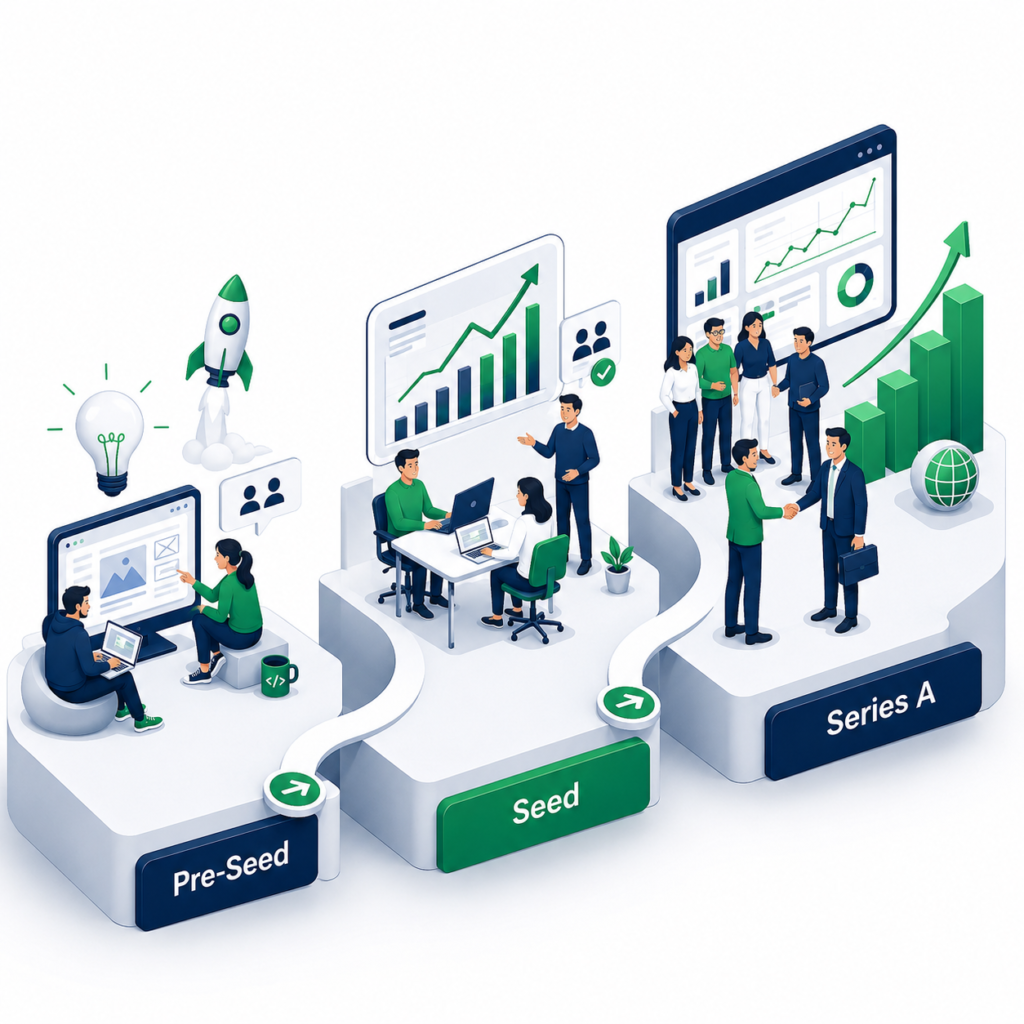
Pre-Seed: Can this work?
Seed: Is it starting to work?
Series A: Can this scale?
There is no universal ARR threshold that automatically moves a startup from one stage to another. Sector, geography, business model, growth, team, and investor expectations all matter. But founders can use practical quantitative benchmarks to understand where they are likely to fit.
1. Pre-Seed vs Seed vs Series A: Quick Comparison
For a B2B SaaS or recurring-revenue startup, this is a useful starting framework:
| Pre-Seed | Seed | Series A | |
|---|---|---|---|
| Main investor question | Can this work? | Is it working? | Can it scale? |
| Product | Prototype or MVP | Commercial product | Proven product |
| Customers | Interviews, pilots, early users | Paying customers | Growing customer base |
| Indicative B2B SaaS ARR | $0–$100K | $100K–$1M+ | $1M–$3M+ |
| Stronger position | Strong validation even without revenue | $300K–$500K+ ARR with growth | $1.5M–$2M+ ARR with strong growth |
| Growth | Early signs | Strong monthly/annual growth | Often 100%+ YoY or strong equivalent |
| Retention | Early evidence | Becoming important | Critical |
| Product-market fit | Being tested | Emerging | Demonstrated |
| Go-to-market | Experimental | Becoming repeatable | Repeatable and scalable |
| Profitability required? | No | No | Usually no |
| Main use of capital | Build and validate | Prove and repeat | Scale |
| Typical investors | Angels, accelerators, pre-seed funds | Seed VCs, micro-VCs, angels | Institutional VCs |
These ARR ranges are guides, not qualification rules. A startup can raise Seed below $100K ARR if other evidence is exceptional, while another company with $1M revenue may still not be Series A-ready.
2. Think About Stage as a Progression
A startup typically moves through something like:
Idea → MVP → Validation → Revenue → Repeatability → Scale
| What You Have Proven | Likely Stage |
|---|---|
| Idea + strong customer research | Pre-Seed |
| MVP + early users | Pre-Seed |
| MVP + pilots/design partners | Pre-Seed |
| First meaningful revenue | Pre-Seed / Seed |
| Growing paying customer base | Seed |
| Early product-market fit | Seed |
| Repeatable customer acquisition | Strong Seed |
| $1M+ ARR + strong growth | Seed / Series A |
| $1.5M–$3M+ ARR + repeatable GTM | Series A |
| Proven economics + scalable growth | Strong Series A |
This is why company age is not a good definition of funding stage.
A four-year-old startup can still be pre-seed if it has not validated demand. A two-year-old startup with millions in recurring revenue may already be ready for Series A.
3. Are You Pre-Seed Ready?
Pre-seed is about validation.
Investors understand that your company may have little or no revenue. They are primarily assessing the founders, customer problem, market opportunity, product direction, and early evidence that customers care.
You are probably in pre-seed territory if you have:
- A clearly defined customer and problem
- Customer interviews or market validation
- An MVP, prototype, or credible development plan
- Early users, pilots, or design partners
- Some evidence customers may eventually pay
- A strong founding team
Example: Pre-Seed Startup
| Metric | Current Position |
|---|---|
| ARR | $0 |
| Customer interviews | 70 |
| Working MVP | Yes |
| Design partners | 6 |
| Active pilots | 3 |
| Paying customers | 0 |
| Proposed raise | $750K |
This company does not need to pretend it is Seed because it already has an MVP.
Its fundraising story is:
“We have validated the problem, built the first product, and secured six design partners. We are raising $750K to convert that validation into our first paying customers.”
That is a credible pre-seed case.
4. Are You Seed Ready?
Seed is where the investor question changes from:
“Does anybody want this?”
to:
“Is there enough evidence that this could become a real business?”
For B2B SaaS, approximately $100K–$1M+ ARR is a useful broad benchmark, with $300K–$500K+ ARR creating a stronger position for many traditional Seed conversations.
But revenue alone does not make a company Seed-ready.
Investors increasingly want evidence around:
- Paying customers
- Revenue growth
- Customer retention
- Pricing
- Gross margin
- Customer acquisition
- Sales pipeline
- Early repeatability
Example: Seed Startup
| Metric | Current Position |
|---|---|
| ARR | $480K |
| Paying customers | 62 |
| YoY growth | 170% |
| Monthly growth | 9–12% |
| Gross margin | 78% |
| Retention | Strong |
| Acquisition channel | Early repeatability |
| Proposed raise | $2M |
This company looks much more like Seed.
Customers are already paying. The investor is now asking:
“Can this company turn its early success into a repeatable growth engine?”
The purpose of the Seed round may be to prove exactly that.
5. Are You Series A Ready?
Series A is not simply a larger Seed round.
At Series A, investors usually expect substantially more evidence.
You should ideally demonstrate:
- Clear product-market fit
- Meaningful recurring revenue or equivalent commercial traction
- Strong growth
- Good retention
- Predictable customer acquisition
- Improving unit economics
- A functioning management team
- A credible plan for scaling
For B2B SaaS, approximately $1M–$3M+ ARR can be a useful broad reference range, with $1.5M–$2M+ ARR combined with strong growth and retention putting many companies in more convincing Series A territory.
Example: Series A Startup
| Metric | Current Position |
|---|---|
| ARR | $2.2M |
| YoY growth | 125% |
| Paying customers | 180 |
| Net revenue retention | 112% |
| Gross margin | 80% |
| Sales process | Repeatable |
| CAC/payback | Measured |
| Active markets | 2 |
| Proposed raise | $10M |
This startup is no longer raising capital primarily to discover whether people want the product.
It is raising to scale something that already works.
The fundraising story changes from:
“Help us prove the business.”
to:
“We have demonstrated the engine. Now we want to scale it.”
6. ARR Does Not Apply Equally to Every Startup
ARR is extremely useful for SaaS and recurring-revenue businesses, but it should not be forced onto every business model.
Different startups need different qualification metrics.
| Business Model | Important Stage Metrics |
|---|---|
| B2B SaaS | ARR, growth, NRR, churn, ACV, CAC payback |
| Consumer App | Active users, engagement, retention, paid conversion |
| Marketplace | GMV, take rate, repeat transactions, liquidity |
| E-commerce / CPG | Net sales, repeat purchase, gross margin, distribution |
| Services | Revenue, recurring revenue, gross margin, customer concentration |
| Hardware | Units sold, orders, gross margin, production economics |
| Deep Tech | Technical validation, pilots, patents, commercial agreements |
| Biotech / Health | Scientific milestones, trials, regulatory progress |
| Pre-Revenue Enterprise | Pilots, LOIs, design partners, conversion potential |
For example, a biotech startup with zero revenue could still be significantly more advanced than a SaaS company with $100K ARR if it has reached an important clinical or regulatory milestone.
Your stage should therefore be evaluated against the metrics that demonstrate risk reduction in your particular business.
7. What If You Are a Service Business?
Revenue alone can be misleading for service-heavy companies.
Imagine your startup generates:
$1.5M annual revenue
That sounds similar to Series A-level revenue for a SaaS business.
But suppose almost all of it comes from founders and employees manually delivering customised consulting projects.
Investors may ask:
“Can revenue grow without headcount growing at almost the same rate?”
That changes the assessment significantly.
For service businesses, evaluate:
| Metric | Why It Matters |
|---|---|
| Revenue | Confirms customer demand |
| Recurring revenue | Shows predictability |
| Gross margin | Helps measure scalability |
| Revenue per employee | Shows operating efficiency |
| Customer concentration | Reveals dependency risk |
| Repeat customers | Demonstrates customer value |
| Productised revenue | Indicates potential to scale beyond labour |
The important question is not simply:
“How much have we sold?”
It is:
“How repeatably and scalably can we continue selling?”
8. Do You Need to Be Profitable?
Usually, no.
Pre-seed, Seed, and Series A companies are frequently loss-making because they are investing in product development and growth.
But investors increasingly care about what the losses are producing.
| Stage | Profitability Expectation |
|---|---|
| Pre-Seed | Usually not important; validation matters more |
| Seed | Losses are normal, but burn should create measurable progress |
| Series A | Profitability is still usually unnecessary, but economics and capital efficiency matter much more |
Consider two startups that both burn $100K per month.
Company A is doubling revenue each year, retaining customers, and improving gross margins.
Company B has flat revenue and declining customer retention.
Their burn rates are identical.
Their investment cases are completely different.
The better question is:
What does every dollar of burn help the company achieve?
9. Your 60-Second Fundraising Stage Test
Use this table to quickly assess where you stand.
| Question | Pre-Seed | Seed | Series A |
|---|---|---|---|
| Customer problem clearly validated? | Required | Required | Required |
| Working product? | Usually | Required | Required |
| Real users/customers? | Helpful | Required | Required |
| Paying customers? | Optional | Usually expected | Expected |
| Strong retention evidence? | Early | Important | Critical |
| Customer acquisition understood? | Testing | Emerging | Repeatable |
| Revenue forecast built from drivers? | Basic | Important | Required |
| Unit economics measured? | Early | Developing | Important |
| Product-market fit demonstrated? | No | Emerging | Yes |
| Capital can accelerate proven growth? | Not yet | Increasingly | Yes |
| Ready for institutional diligence? | Basic | Increasingly | Yes |
10. Three Startups, Three Different Stages
Startup A
MVP built
4 pilots
No revenue
Raising $500K
Likely stage: Pre-Seed
The company needs to prove commercial demand.
Startup B
$420K ARR
55 paying customers
Approximately 10% monthly revenue growth
Early repeatable acquisition
Raising $2M
Likely stage: Seed
The company needs to turn early product-market fit into repeatable growth.
Startup C
$2.4M ARR
More than 100% annual growth
Strong retention
Predictable sales process
Raising $10M
Likely stage: Series A
The company has a functioning growth engine and needs capital to scale it.
Notice that the difference is not primarily the amount they want to raise.
The difference is:
What has already been proven before the investment?
11. What Investors Need You to Prove at Each Stage
This is perhaps the simplest comparison in the article.
| Pre-Seed | Seed | Series A | |
|---|---|---|---|
| Problem | Proven | Proven | Proven |
| Product | MVP | Commercial | Proven |
| Demand | Early evidence | Paying customers | Strong evidence |
| Revenue | Optional | Increasingly important | Usually important |
| Retention | Early | Developing | Strong |
| GTM | Testing | Finding repeatability | Repeatable |
| Economics | Early assumptions | Becoming measurable | Clearly understood |
| Team | Strong founders | Core team forming | Leadership depth increasing |
| Capital purpose | Validate | Repeat | Scale |
Or even more simply:
Pre-Seed = Problem + Team + Validation
Seed = Product + Customers + Early Repeatability
Series A = Product-Market Fit + Growth + Scalability
12. Raise for the Stage You Are, Not the Stage You Want to Be
Calling a round “Series A” does not make the startup Series A-ready.
Neither does raising a large amount.
Your fundraising stage should follow the evidence.
If you are pre-seed, build your investment case around why the problem matters, why your team can solve it, and what your early validation shows.
If you are Seed, demonstrate that real customers are paying and that the company is beginning to understand how to grow repeatedly.
If you are Series A, demonstrate that the growth engine already works and that additional capital can scale it.
Which Funding Stage Should You Target?
If you are still unsure, answer three questions:
What have we already proven?
What are investors still being asked to believe?
What will this funding round allow us to prove next?
Those answers usually reveal your real fundraising stage more accurately than the name written on your pitch deck.
Before starting investor outreach, your fundraising stage, pitch deck, financial model, round size, valuation expectations, and investor list should all tell the same story.
You can continue with:
How Much Should You Raise? Calculating the Right Funding Round
Financial Model Check: Will Your Numbers Hold Up in an Investor Meeting?
How to Find the Right Investors for Your Startup
Startup Fundraising Timeline: What to Do 12 Months Before You Raise
At GetPitchRaise, we support early-stage founders with Pitch Deck and Financial Model Assessment, Fundraising Material Development, and Investor Outreach.
Not Sure Whether You Are Investor Ready?
Book a free consultation call now to review your fundraising materials and prepare for investor outreach.