Fundraising should not begin when your startup is almost out of cash.
A strong fundraising process usually starts months before the first investor email. Founders need time to improve traction, prepare the financial story, organise the data room, identify suitable investors, and build relationships before asking for capital.
The purpose of a 12-month fundraising timeline is not to spend an entire year pitching investors. It is to make sure the company is ready when outreach begins.
12 to 10 Months Before: Define the Next Fundraising Milestone
Start by deciding what the company must achieve before the next round.
Investors do not fund a list of expenses. They fund progress.
Your milestone may be:
- Reaching a specific revenue level
- Launching the commercial product
- Converting pilots into paid contracts
- Proving customer retention
- Entering a new market
- Receiving regulatory approval
- Building a repeatable acquisition channel
For example, instead of saying:
We plan to raise $1.5 million to hire people and grow.
Define the result:
We plan to raise $1.5 million to complete the enterprise product, hire the first commercial team, and grow from $250,000 to $1.2 million ARR over approximately 18 months.
This gives you a clear basis for the financial model, fundraising amount, and investor story.
At this stage, estimate when your current cash will run out. Ideally, outreach should begin while the company still has enough runway to negotiate without desperation.
10 to 8 Months Before: Strengthen the Metrics Investors Will Review
Use this period to improve the evidence supporting your fundraising story.
The relevant metrics depend on your stage.
Pre-seed example
A pre-seed company may focus on:
- Customer interviews
- Design partners
- Product usage
- Pilot agreements
- Waiting-list growth
- Technical progress
Example:
The team completed 60 customer interviews, built a working product, and secured five design partners testing it every week.
Seed example
A seed company may focus more on:
- Paying customers
- Monthly recurring revenue
- Growth
- Retention
- Pilot conversion
- Customer-acquisition efficiency
Example:
Revenue increased from $12,000 to $39,000 MRR in nine months, while monthly churn declined from 5% to 2.8%.
Series A example
A Series A company will normally need stronger evidence of repeatability:
- ARR growth
- Net revenue retention
- Gross margin
- Sales efficiency
- Customer concentration
- Expansion revenue
- Repeatable go-to-market channels
Do not wait until the fundraising process begins to discover that your strongest metric is unclear or poorly tracked.
8 to 6 Months Before: Build the Financial Model
Your financial model should explain how the business grows and how much capital is required.
It should connect:
Customers → pricing → revenue → hiring → costs → burn → runway.
Review:
- Revenue assumptions
- Pricing
- Customer growth
- Churn
- Gross margin
- Hiring dates
- Sales and marketing spending
- Monthly burn
- Runway
- Base and downside scenarios
- Future funding needs
The financial model should be built from business drivers, not from a desired final revenue number.
For example, rather than assuming revenue grows by 15% each month, show how many customers each salesperson can close, the average contract value, and the expected sales cycle.
This is also the time to decide how much you should raise. The amount should be large enough to reach a meaningful milestone with a reasonable buffer.
For more detail, link this section to:
Financial Model Check: Will Your Numbers Hold Up in an Investor Meeting?
6 to 5 Months Before: Review the Cap Table and Legal Structure
Before approaching investors, confirm that the company’s ownership records are accurate.
Review:
- Founder ownership
- Founder vesting
- Employee options
- Adviser grants
- SAFEs
- Convertible notes
- Warrants
- Previous investment documents
- Fully diluted ownership
A cap table problem can delay or damage an otherwise promising round.
For example, if a former contractor was promised equity but no agreement was signed, resolve the issue before investor diligence begins.
You should also model the likely dilution from the proposed round.
If you raise $2 million at an $8 million pre-money valuation, the basic post-money valuation is $10 million and the investor receives 20%. However, SAFEs, notes, and option-pool increases may create additional dilution.
For more detail, internally link to:
Building a Strong Cap Table: A Guide to Your Startup’s Ownership Structure
5 to 4 Months Before: Prepare the Pitch Deck and Fundraising Story
Your pitch deck should explain the investment case clearly.
The investor should quickly understand:
- What the company does
- Which customer problem it solves
- Why the timing is attractive
- What evidence shows demand
- How the business makes money
- Why the market can become large
- Why the team can win
- How much you are raising
- What the capital will achieve
Avoid building the deck as a collection of company facts.
The slides should form a logical story.
A useful test is to read only the slide headlines. They should still communicate the main investment argument.
Example:
Weak headline
Traction
Stronger headline
Revenue grew 3.2× over the past 12 months
Before moving forward, check that the numbers in the deck match the financial model.
For more detail, link to:
Pitch Deck Review Before an Investor Meeting: The Complete Founder Checklist
4 to 3 Months Before: Build the Investor Data Room
Do not wait until an investor requests due-diligence documents.
Prepare a simple data room containing:
| Folder | Main Documents |
|---|---|
| Company | Incorporation and governance records |
| Ownership | Cap table, SAFEs, notes, previous financing |
| Financials | Historical results, model, budget, cash flow |
| Customers | Revenue, contracts, retention, pipeline |
| Product | Overview, demo, roadmap |
| Legal and IP | Material contracts, IP assignments, licenses |
| Team | Founder, employee, contractor, and option documents |
| Fundraising | Deck, use of funds, milestones, dilution model |
The data room should support the claims in your pitch deck.
If the deck says the company has 80 paying customers, the commercial folder should contain evidence that supports that statement.
Access should be shared in stages. Initial investors usually receive the deck and selected metrics. More sensitive financial, customer, legal, and employment documents can be shared after serious interest develops.
For more detail, link to:
How to Build an Investor Data Room That Speeds Up Fundraising
3 Months Before: Define Your Investor Profile
Before building an investor list, define what a suitable investor looks like.
Your target profile should include:
- Stage
- Sector and subsector
- Geography
- Check size
- Round size
- Investor type
- Relevant portfolio experience
- Lead or follow-on preference
- Current investment activity
Example:
A European B2B fintech startup raising a $1.5 million seed round should prioritize active pre-seed and seed investors in Europe and the US that invest in payments, financial infrastructure, or SME software and write initial checks between $200,000 and $700,000.
This is more useful than searching for “top fintech investors.”
Investor fit matters more than database size.
For more detail, link to:
How to Find the Right Investors for Your Startup
10 to 8 Weeks Before: Build and Prioritize the Investor List
Create a structured investor database containing:
- Investor name
- Firm
- Role
- Stage
- Sector
- Geography
- Check size
- Recent investments
- Relevant portfolio companies
- Possible conflicts
- Priority
- Outreach status
Separate investors into priority groups.
Priority A
Strong fit across stage, sector, geography, check size, and recent activity.
Priority B
Good fit, but one area needs confirmation.
Priority C
Possible fit with weaker evidence of alignment.
Your highest-priority investors should receive the strongest preparation and personalization.
Do not contact all investors on the same day.
8 to 6 Weeks Before: Prepare the Outreach Campaign
Create a concise outreach email that explains:
- Why you selected the investor
- What the company does
- The strongest traction
- How much you are raising
- The next requested action
Example:
Hi Sarah,
I noticed your investments in vertical SaaS and logistics software.
We help regional freight operators reduce empty journeys through automated route planning. We currently support 72 fleets and have grown to $44K MRR.
We are raising a $1.6M seed round to expand the commercial team and enter two additional European markets.
Would you be open to reviewing our deck?
Prepare follow-up messages before launching the campaign.
For more detail, link to:
Investor Outreach Emails That Get Replies: How Founders Can Win More VC Responses
4 to 2 Weeks Before: Rehearse the Investor Meeting
Practise presenting the deck aloud.
Focus on:
- The opening explanation
- Main traction figures
- Market calculation
- Financial assumptions
- Competition
- Burn and runway
- Fundraising amount
- Use of funds
- Milestones
Prepare for likely investor questions.
For example:
| Topic | Likely Question |
|---|---|
| Traction | Is the growth repeatable? |
| Revenue | What drives the forecast? |
| Retention | Why do customers leave? |
| Market | Can this become venture-scale? |
| Competition | Why will you win? |
| Financials | What happens if growth is slower? |
| Fundraising | Why do you need this exact amount? |
Do not memorise a speech word for word. Know the main message of every slide and the evidence supporting it.
Launch Month: Run Fundraising as a Process
Once outreach begins, manage the round actively.
Track:
- Emails sent
- Replies
- Meetings
- Investor feedback
- Follow-ups
- Data-room access
- Partner meetings
- Diligence requests
- Next steps
- Verbal and written commitments
Try to create a focused meeting period rather than spreading conversations across many months.
Fundraising momentum develops when multiple relevant investors review the opportunity during a similar period.
Do not create false urgency. Use real process updates.
Example:
We are completing first meetings this month and expect to begin partner discussions shortly.
During the Raise: Improve Without Constantly Rebuilding
Investor feedback can improve the process, but do not rewrite the entire pitch after every meeting.
Look for repeated patterns.
If several investors question the same issue, it may need attention.
Examples include:
- Unclear market size
- Weak customer retention
- Unsupported growth assumptions
- Poor investor fit
- Unclear differentiation
- An unrealistic valuation
- A fundraising amount disconnected from milestones
Change the materials when the feedback reveals a genuine weakness, not simply because one investor has a different preference.
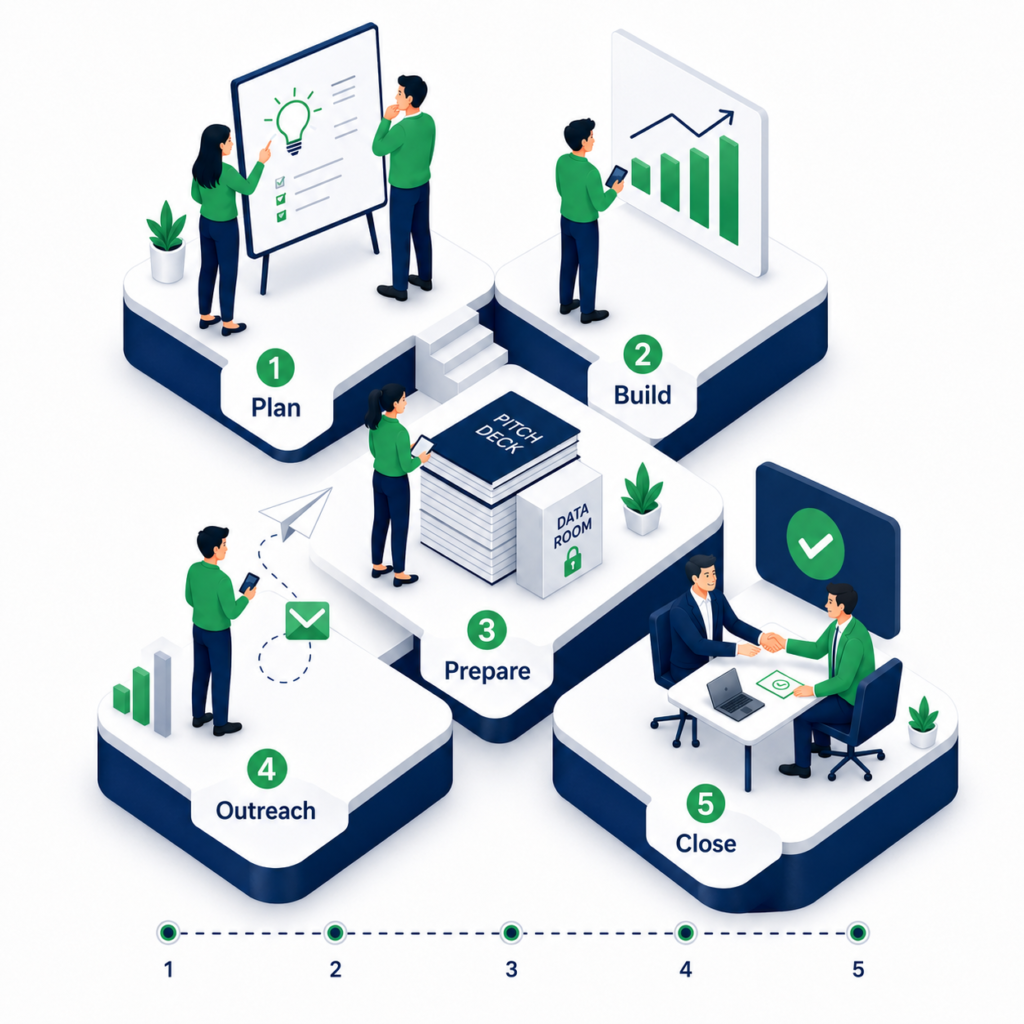
The 12-Month Fundraising Timeline
| Timing | Main Priority |
|---|---|
| 12–10 months before | Define milestones and runway |
| 10–8 months before | Strengthen traction and metrics |
| 8–6 months before | Build the financial model |
| 6–5 months before | Clean up the cap table and legal structure |
| 5–4 months before | Prepare the pitch deck and story |
| 4–3 months before | Build the investor data room |
| 3 months before | Define the ideal investor profile |
| 10–8 weeks before | Build and prioritise the investor list |
| 8–6 weeks before | Prepare outreach emails and follow-ups |
| 4–2 weeks before | Rehearse investor meetings |
| Launch month | Run structured investor outreach |
| During the raise | Track momentum, feedback, and diligence |
Start Fundraising Before You Need the Money
The strongest time to raise is when the company can show progress and still has enough runway to negotiate carefully.
Starting early gives founders time to:
- Improve traction
- Correct financial inconsistencies
- Resolve cap-table issues
- Prepare the data room
- Research relevant investors
- Build relationships
- Run a structured campaign
At GetPitchRaise, we support early-stage founders with:
- Pitch Deck and Financial Model Assessment
- Fundraising Material Development
- Investor Outreach
Are You Planning to Raise Within the Next 12 Months?
Book a free consultation call now to review your fundraising materials and prepare for investor outreach.