
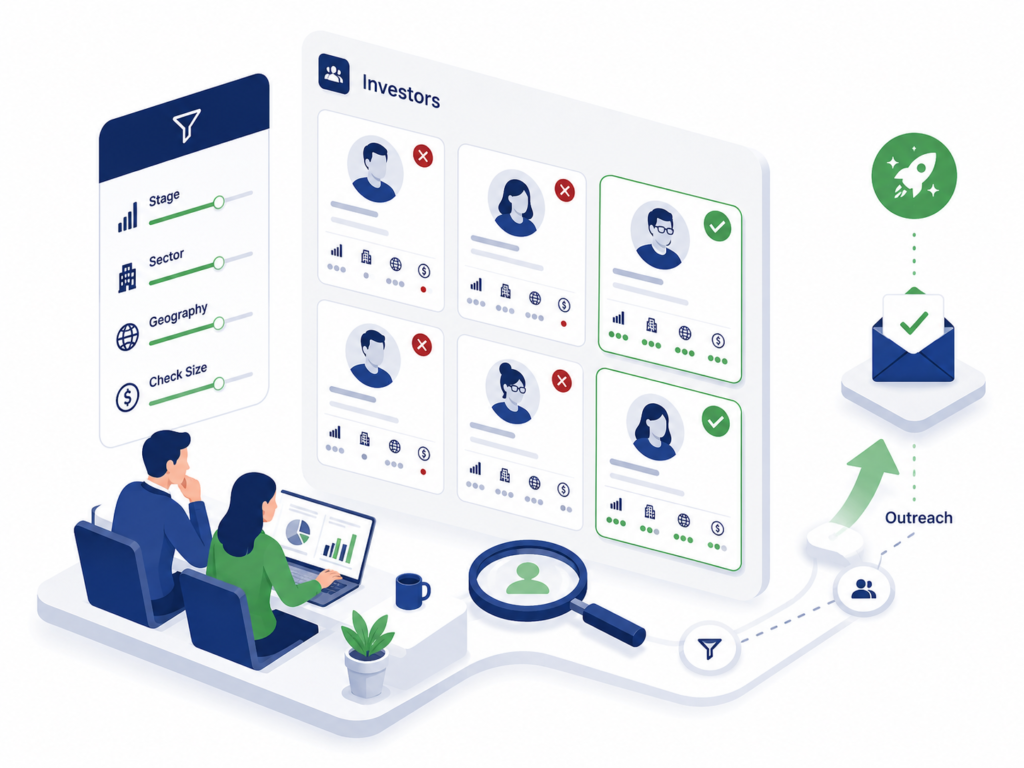
Most founders do not struggle to find investor names.
They struggle to find investors who are genuinely suitable for their company.
A database may contain thousands of angels and venture funds, but that does not mean they are all realistic prospects. An investor may like your sector but only invest at Series B. Another may invest at your stage but only in the United States. A third may have the right check size but already back one of your direct competitors.
Sending your pitch deck to all of them will not improve your odds. It will create more work, more rejection, and less time to focus on the investors who could actually participate in your round.
The goal is not to contact as many investors as possible.
The goal is to identify investors who have a clear reason to consider your startup.
Here is how to build a focused investor list and approach the right people.
1. Define Your Fundraising Profile First
Before researching investors, define exactly what you are raising.
Many founders start searching with broad phrases such as “fintech investors” or “seed-stage VCs.” That is not specific enough.
Your fundraising profile should include:
- Current funding stage
- Amount being raised
- Preferred investor type
- Sector and subsector
- Business model
- Target geography
- Current traction
- Expected check size
- Planned use of funds
- Key milestones after the round
For example:
We are a UK-based B2B fintech startup raising a $1.5 million seed round. We are looking for European and US investors who write initial checks between $200,000 and $700,000 and have experience in payments, financial infrastructure, or SME software.
That description gives you a practical filter.
Without it, almost every investor may appear relevant at first. With it, you can quickly remove investors who do not fit your round.
2. Match the Investor to Your Stage
Investment stage is one of the first filters to apply.
A well-known venture fund may look attractive, but it is not useful when its minimum investment is larger than your entire round.
Investors may describe their focus using terms such as:
- Pre-seed
- Seed
- Series A
- Early stage
- Growth stage
- Multi-stage
Do not rely only on how the fund describes itself. Review its recent investments.
A “seed investor” may now mainly participate in larger institutional rounds. A multi-stage fund may technically invest at pre-seed but only make a few very selective early bets each year.
Look at the size and timing of its first investment in portfolio companies.
For a pre-seed startup, relevant targets may include:
- Angel investors
- Angel syndicates
- Accelerators
- Micro-VC funds
- Early-stage family offices
- Sector-focused seed funds
For a Series A company, the target list will usually shift toward institutional investors with larger check sizes, follow-on capacity, and experience supporting scale.
Stage fit matters because investors evaluate companies according to different expectations.
A pre-seed investor may focus on the founders, insight, market, and early validation. A Series A investor may expect repeatable growth, stronger retention, clearer unit economics, and a developed go-to-market engine.
3. Check the Investor’s Real Check Size
The investor’s check size should fit both your total round and the amount you expect from that investor.
Suppose you are raising $800,000.
An investor whose typical first check is $2 million is unlikely to participate. An angel who normally invests $15,000 may still be relevant, but you would need many similar investors to complete the round.
Review:
- Minimum initial check
- Typical initial check
- Maximum check
- Whether the investor leads rounds
- Whether it follows another lead
- Follow-on investment capacity
- Preferred ownership percentage
The right investor is not simply someone who can afford to invest.
The investment must also make sense within the investor’s portfolio strategy.
Some funds need to own a meaningful percentage of the company. Others are comfortable participating with smaller checks. Some only invest when they can lead the round, while others prefer to join after a lead investor has committed.
Understanding this early prevents unnecessary conversations.
4. Go Beyond Broad Sector Labels
“Technology,” “healthcare,” and “AI” are too broad to determine investor fit.
A fund that invests in healthcare may focus on drug discovery rather than healthcare software. An AI investor may prefer infrastructure and foundational models rather than AI-enabled consumer applications.
Look for subsector and business-model alignment.
For example:
| Broad Sector | More Useful Investor Fit |
|---|---|
| Fintech | Payments, lending, insurance technology, compliance or financial infrastructure |
| SaaS | Vertical SaaS, developer tools, enterprise software or sales technology |
| Healthcare | Digital health, medical devices, diagnostics or biotechnology |
| AI | Infrastructure, enterprise applications, robotics or specialised industry solutions |
| Consumer | Marketplaces, subscriptions, social platforms or consumer products |
Also check whether the investor prefers:
- B2B or B2C
- Software or hardware
- Recurring revenue or transactional models
- Regulated or unregulated industries
- Capital-light or capital-intensive businesses
A precise sector match gives the investor a stronger reason to understand your opportunity.
5. Review Geography Carefully
Geography affects investor targeting in several ways.
Some investors only back startups incorporated in specific countries. Others invest internationally but require the company to establish a presence in their main market. Some will invest remotely, while others prefer founders located nearby.
Check:
- Where the fund is based
- Where its portfolio companies are located
- Whether it invests outside its home market
- Whether it has regional partners
- Whether your company structure is acceptable
- Whether your target market fits its strategy
Do not assume that an investor is internationally active because its website says “global.”
Recent portfolio activity usually provides a more reliable picture.
For startups raising across Europe, the United States, or MENA, geography should be treated as a core filter—not an afterthought.
6. Study Recent Investments, Not Old Portfolio Pages
An investor’s current activity matters more than an investment it made six years ago.
Review recent deals to understand:
- Whether the investor is still actively deploying capital
- Which stages it currently prefers
- Which sectors are receiving attention
- Whether its average check size has changed
- Which partners are leading relevant investments
- Whether it has recently raised a new fund
A portfolio may show that an investor once backed a company similar to yours. Recent activity may reveal that its strategy has shifted.
Look for investments made during the past one to two years, where possible.
Also identify the specific partner, principal, or angel responsible for those investments. Contacting the right person within a fund is usually more effective than sending your pitch to a general inbox.
7. Watch for Portfolio Conflicts
A close portfolio match can be a positive signal because the investor understands your market.
It can also create a conflict.
Review whether the investor already backs:
- A direct competitor
- A company targeting the same customers
- A product with significant feature overlap
- A business that may enter your segment
- A company operating with the same sensitive data or technology
Not every overlap is a problem. Some investors build investment themes and support several companies in adjacent areas.
However, direct competition can affect whether the investor is willing to engage and how much confidential information you should share early in the process.
During initial outreach, provide enough information to create interest without revealing highly sensitive commercial or technical details.
8. Identify the Right Person Inside the Fund
Finding the right fund is only half of the work.
You also need the right contact.
Different partners within the same firm may focus on different sectors, stages, or geographies. A general submission form may reach the firm, but a relevant partner is more likely to understand why the opportunity fits.
Research the individual’s:
- Current role
- Investment focus
- Portfolio companies
- Board positions
- Recent deals
- Public writing or interviews
- Geographic responsibility
- Typical company stage
For smaller funds, the relevant person may be a managing partner or general partner. Larger funds may have dedicated partners for fintech, healthcare, enterprise software, or regional investments.
Your message should show why you selected that person.
For example:
I noticed your investments in financial infrastructure and SME software. We are building a payments platform for independent European retailers and have grown transaction volume by 18% month over month during the past six months.
That is more relevant than saying:
I saw that your firm invests in technology companies.
9. Look for Evidence of Investor Activity
An investor profile may exist online even when the investor is no longer actively investing.
Before adding someone to your priority list, look for activity signals such as:
- Recent investments
- A newly announced fund
- Portfolio announcements
- Active partner commentary
- Participation in current startup events
- New board appointments
- Recent fundraising-related posts
- Current accelerator mentorship
An inactive investor may still respond, but should not receive the same priority as someone clearly deploying capital.
You can classify investors as:
- Active: Recent, relevant investments and visible deployment
- Likely active: Current role and recent industry activity, but limited deal information
- Unclear: No recent evidence of investment activity
- Inactive or low priority: Role changed, fund closed, or no meaningful activity
This prevents your outreach list from becoming filled with outdated contacts.
10. Prioritise Investors Instead of Treating Everyone Equally
Not every investor on your list should receive the same attention.
Create priority groups based on fit.
Priority A: Strong Fit
These investors match your stage, sector, geography, check size, and business model. They are currently active and have relevant portfolio experience.
These contacts deserve the most personalised outreach.
Priority B: Good Fit
They match most criteria but may have one uncertainty, such as geography, check size, or current activity.
They are still worthwhile but may require additional research.
Priority C: Possible Fit
These investors have partial relevance but lack strong evidence of alignment.
They can be contacted later, after you test your positioning with higher-priority investors.
A simple scoring model can help:
| Criterion | Suggested Score |
|---|---|
| Stage match | 0–2 |
| Sector match | 0–2 |
| Geography match | 0–2 |
| Check-size match | 0–2 |
| Recent activity | 0–2 |
| Relevant portfolio experience | 0–2 |
| Warm-introduction opportunity | 0–2 |
An investor with a score of 12 or 13 should not be treated the same as one scoring 5.
The score does not replace judgment. It helps you use your time more effectively.
11. Search for Warm Introduction Paths
A warm introduction is not always possible, but it is worth checking.
Potential introduction sources include:
- Existing investors
- Founders in the investor’s portfolio
- Accelerators
- Advisors
- Lawyers
- Accountants
- Industry operators
- Former colleagues
- University networks
- Angel communities
The best introduction usually comes from someone who knows both the founder and investor well enough to explain why the connection is relevant.
Avoid asking someone for a vague introduction to “any investors they know.”
Make the request specific:
We are raising a $1.2 million seed round for our B2B logistics platform. I noticed you know Sarah at Example Ventures, which invests in supply-chain software. Would you feel comfortable introducing us?
Give the person a short forwardable summary so that making the introduction requires minimal effort.
12. Build a Research-Based Investor Database
A useful investor list should contain more than names and email addresses.
Track the information needed to decide why the investor belongs on the list.
| Field | Why It Matters |
|---|---|
| Investor and firm | Identifies the decision-maker |
| Role | Confirms their ability and focus |
| Email and LinkedIn | Supports outreach |
| Stage | Confirms round fit |
| Sector and subsector | Shows investment relevance |
| Geography | Confirms regional fit |
| Check size | Aligns with your round |
| Recent investment | Shows current activity |
| Relevant portfolio company | Supports personalisation |
| Lead or follower | Helps structure the round |
| Priority | Focuses outreach effort |
| Outreach status | Prevents missed follow-ups |
| Notes | Records feedback and next steps |
Your database should remain active throughout the campaign.
Update it after every email, meeting, introduction, and investor response.
13. Avoid Buying a List and Sending One Generic Email
A large investor database can save research time, but it should not become a substitute for targeting.
Even a vetted list must be filtered according to your company.
Sending the same email to 1,000 investors can create several problems:
- Low response rates
- Poor investor relevance
- Damaged sender reputation
- Weak first impressions
- Unsubscribe or spam complaints
- Difficulty tracking meaningful conversations
Use a database as a starting point.
Then verify the investor, confirm current fit, identify the correct contact, and personalise the reason for reaching out.
The quality of your list is determined by relevance—not its number of rows.
14. Test Your Investor List Before Launching the Full Campaign
Do not contact your entire list on the first day.
Start with a smaller group of relevant investors and observe:
- Email open and reply rates
- Which subject lines perform better
- Whether investors understand the business
- Which objections appear repeatedly
- Whether your traction is compelling
- Whether the fundraising ask feels credible
- Whether investors request the deck or a meeting
Use that feedback to improve your materials and messaging before approaching the highest-priority investors.
However, do not use obviously unsuitable investors merely as practice. Your test group should still contain legitimate prospects.
The Right-Investor Checklist
Before adding an investor to your outreach campaign, ask:
| Question | What to Confirm |
|---|---|
| Does the investor fund our stage? | Recent investments at pre-seed, seed, or Series A |
| Does the check size fit? | Realistic initial investment for your round |
| Does the sector match? | Relevant subsector and business-model experience |
| Does the geography fit? | Active investment in your region or company structure |
| Is the investor active? | Recent investments or current deployment signals |
| Is there a conflict? | No unacceptable direct portfolio competition |
| Who is the right person? | Relevant partner, principal, or angel |
| Why would they care? | A specific connection between their strategy and your company |
| Can we get introduced? | A credible mutual connection where available |
| What is the priority? | Strong, good, or possible fit |
Finding Investors Is a Matching Process
Fundraising is not a numbers game in the simplest sense.
Contacting more investors may create more opportunities, but only when the investors are reasonably matched to your company.
A focused investor list helps you:
- Spend more time on relevant opportunities
- Write better outreach messages
- Improve response rates
- Create stronger investor conversations
- Understand the likely structure of your round
- Reduce unnecessary rejection
- Manage fundraising more efficiently
The right investor brings more than capital. They may provide sector knowledge, customer introductions, hiring support, credibility, and future fundraising connections.
That is why investor research should be treated as part of the fundraising strategy—not as an administrative task completed at the last minute.
Build Your Investor Outreach on the Right Foundation
Before contacting investors, your company needs a clear fundraising story, consistent financials, investor-ready materials, and a properly targeted list.
At GetPitchRaise, we support early-stage founders through three stages:
1. Pitch Deck and Financial Model Assessment
We review your existing deck and financial model to identify unclear messaging, inconsistencies, unsupported assumptions, and questions investors may raise.
2. Fundraising Material Development
We help develop materials that communicate the opportunity clearly and present one consistent investment case.
3. Investor Outreach
We research relevant investors and help manage a structured outreach process based on your stage, sector, geography, check size, and fundraising objectives.
Are You Contacting the Right Investors?
Book a free consultation call now to review your fundraising materials and prepare for investor outreach.