Fundraising in 2026 is not only about having a promising idea.
Investors want to understand the business quickly, see evidence that customers care, and know exactly what their capital will help the company achieve.
The strongest founders do not simply describe their startup. They present a clear investment case.
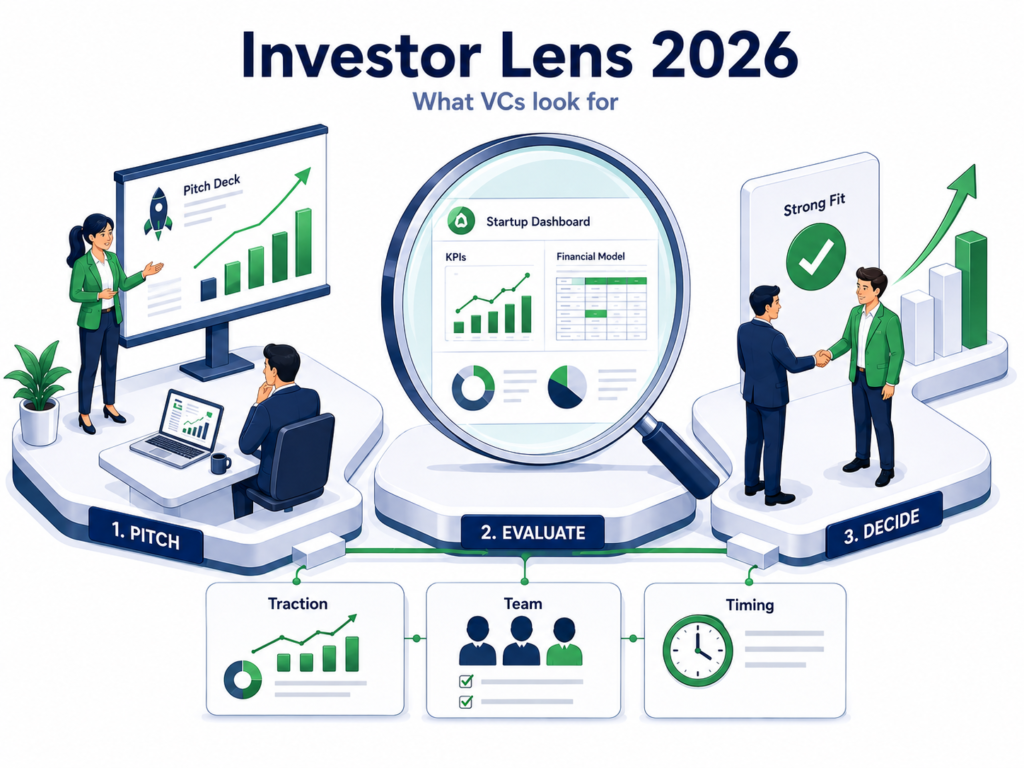
Here is how investors may evaluate your company—and how to make each part more convincing.
Financial Model: 1. Can Investors Understand the Business Quickly?
Investors should know what you do within the first few slides of your pitch deck.
Too vague
We are building an intelligent platform that transforms business operations.
Clearer
We help independent retailers predict demand and reduce unsold inventory.
The second version immediately explains:
- Who the customer is
- What the product does
- Which problem it solves
- Why the customer may pay
Clarity is especially important when investors are reviewing many opportunities. A complicated description can make a strong business appear unfocused.
A useful test is to ask someone unfamiliar with your startup to describe it after reviewing the opening slides. When their explanation is different from yours, the message probably needs work.
2. Is the Problem Important Enough?
A real problem is not automatically an investable problem.
Investors want to know how frequently the problem occurs, how much it costs customers, and why existing solutions are not good enough.
Weak example
Managing deliveries is difficult for small logistics companies.
Stronger example
Regional delivery companies lose an average of eight hours per dispatcher each week because routes, drivers, and customer updates are managed across separate tools.
The stronger version makes the problem more specific and measurable.
Useful evidence may include:
- Customer interviews
- Lost time or revenue
- Existing spending on alternatives
- Operational delays
- Compliance risks
- Customer complaints
- Industry changes
The problem should feel important enough that customers will actively search and pay for a solution.
3. What Evidence Shows That Customers Care?
Investors do not expect every early-stage company to have substantial revenue. They do expect evidence appropriate to its stage.
Pre-seed example
We interviewed 72 clinic managers, built the first working product, and secured five design partners testing it weekly.
Seed example
We grew from 14 to 68 paying customers in ten months and reached $46,000 in monthly recurring revenue.
Series A example
We reached $4.2 million ARR, grew 110% over the past year, and maintained 115% net revenue retention.
The evidence becomes stronger as the startup matures.
Investors may look at:
- Revenue growth
- Paying customers
- Retention
- Usage frequency
- Pilot conversion
- Signed contracts
- Product engagement
- Customer-acquisition efficiency
Avoid presenting numbers without context.
Less useful
We have 20,000 users.
More useful
We grew from 5,000 to 20,000 registered users in eight months, with 42% returning every week.
Context helps investors understand whether the number represents meaningful progress.
4. Can the Company Become Large?
A good small business is not automatically a venture-scale opportunity.
Investors need to see how the startup can grow beyond its first customer group.
Consider a company selling software to independent dental clinics.
Its expansion path might be:
Start with appointment scheduling for independent clinics, expand into patient communication and billing, then serve larger clinic groups across several countries.
That is more convincing than simply saying:
The global healthcare market is worth billions.
A strong market story explains:
- Which segment you will enter first
- Why you can win that segment
- How you will expand afterward
Practical example
Our initial market is 12,000 private clinics in Germany. After building distribution through clinic associations, we plan to expand into Austria, Switzerland, and larger medical groups.
Investors want a focused starting point and a credible path toward a larger outcome.
5. Does the Financial Model Support the Story?
Investors know that forecasts will change. They still expect the logic behind them to make sense.
Suppose your model predicts revenue increasing from $500,000 to $5 million within two years.
The investor will ask:
- How many customers are required?
- What will each customer pay?
- How many salespeople will you need?
- How long is the sales cycle?
- How much will acquisition cost?
- What happens to burn and runway?
Weak forecast
Revenue will grow by 15% every month.
Stronger forecast
Six sales representatives will each manage 20 qualified opportunities per quarter. At a 22% conversion rate and an average annual contract value of $28,000, this supports the base-case forecast.
The model should connect:
Customers → pricing → revenue → costs → burn → runway.
Your pitch deck and financial model must also agree. When the deck promises expansion into three markets, the model should include the hiring, marketing, legal, and operating costs required to enter them.
6. Why Is This Team Right for the Opportunity?
A team slide should do more than list previous employers.
Investors want to understand why the founders have a specific advantage in building this company.
Generic example
Our team has more than 25 years of combined experience.
Stronger example
Our CEO previously managed operations for 400 retail locations, while our CTO built demand-forecasting systems used by two national chains.
The stronger version connects experience directly to the problem.
Founder-market fit may come from:
- Direct industry experience
- Technical expertise
- Personal experience with the problem
- Customer relationships
- Regulatory knowledge
- Previous startup execution
- Access to specialised data or distribution
The investor should leave the team slide thinking:
These founders understand the problem deeply and are unusually well positioned to solve it.
7. Why Will the Company Win?
Saying that you have no competitors usually weakens credibility.
Customers are already solving the problem somehow—even when they use spreadsheets, consultants, manual work, or no formal product.
Weak competition claim
We have no direct competitors.
Better explanation
Customers currently use spreadsheets and legacy accounting tools. Our advantage is automated reconciliation, a two-day implementation process, and integrations with the systems they already use.
A defensible advantage may come from:
- Proprietary technology
- Unique data
- Strong distribution
- Industry partnerships
- Network effects
- Regulatory approval
- Switching costs
- Workflow integration
- Brand or community
Investors want to know not only why your product is better today, but why it will remain difficult to copy.
8. Why Are You Raising This Amount?
Your fundraising ask should explain what the investment will achieve.
Weak ask
We are raising $2 million for product development, hiring, and marketing.
Stronger ask
We are raising $2 million to complete the enterprise product, hire four commercial team members, and grow from $600,000 to $2.1 million ARR over approximately 18 months.
The stronger version connects capital to progress.
Your ask should cover:
- The amount being raised
- Expected runway
- Key hires
- Product milestones
- Commercial milestones
- The position expected before the next round
Investors are not only funding expenses. They are funding the company’s movement toward a more valuable and less risky stage.
9. Are You Contacting the Right Investors?
A strong company can still receive poor results when it approaches unsuitable investors.
Imagine a B2B fintech startup raising a $1.5 million seed round.
Poor target
A growth-stage consumer investor whose typical check is $10 million.
Stronger target
An early-stage fintech fund investing in Europe with initial checks between $300,000 and $800,000.
Before contacting an investor, verify:
- Stage
- Sector and subsector
- Geography
- Check size
- Recent investments
- Relevant portfolio companies
- Current activity
- Possible conflicts
Investor fit also improves your outreach message.
Generic email opening
I believe our startup may be relevant to your investment strategy.
More relevant opening
I noticed your investments in payments infrastructure and SME financial software. We are building an automated cash-flow platform for European wholesalers and recently reached $38,000 MRR.
The second message gives the investor an immediate reason to continue reading.
The Investor Lens Checklist
| Investor Question | What You Need to Demonstrate |
|---|---|
| What does the company do? | A simple, specific explanation |
| Is the problem important? | Evidence of cost, urgency, or customer pain |
| Do customers care? | Stage-appropriate traction |
| Can this become large? | A focused entry market and expansion path |
| Are the numbers credible? | Clear assumptions and consistent financials |
| Why this team? | Relevant expertise and execution ability |
| Why will you win? | A meaningful, defensible advantage |
| Why this amount? | Capital connected to runway and milestones |
| Why this investor? | Clear stage, sector, geography, and check-size fit |
Investors Fund Clarity, Evidence, and Potential
Investors do not expect early-stage companies to have removed every risk.
They want to see that the founders understand the major risks, are reducing them with evidence, and have a credible plan for using new capital.
A strong fundraising case makes it easy to understand:
What the company does, why customers care, why it can become large, why this team can win, and what the investment will achieve.
At GetPitchRaise, we support early-stage founders with:
- Pitch Deck and Financial Model Assessment
- Fundraising Material Development
- Investor Outreach
Is Your Startup Ready for the Investor Lens?
Book a free consultation call now to review your fundraising materials and prepare for investor outreach.