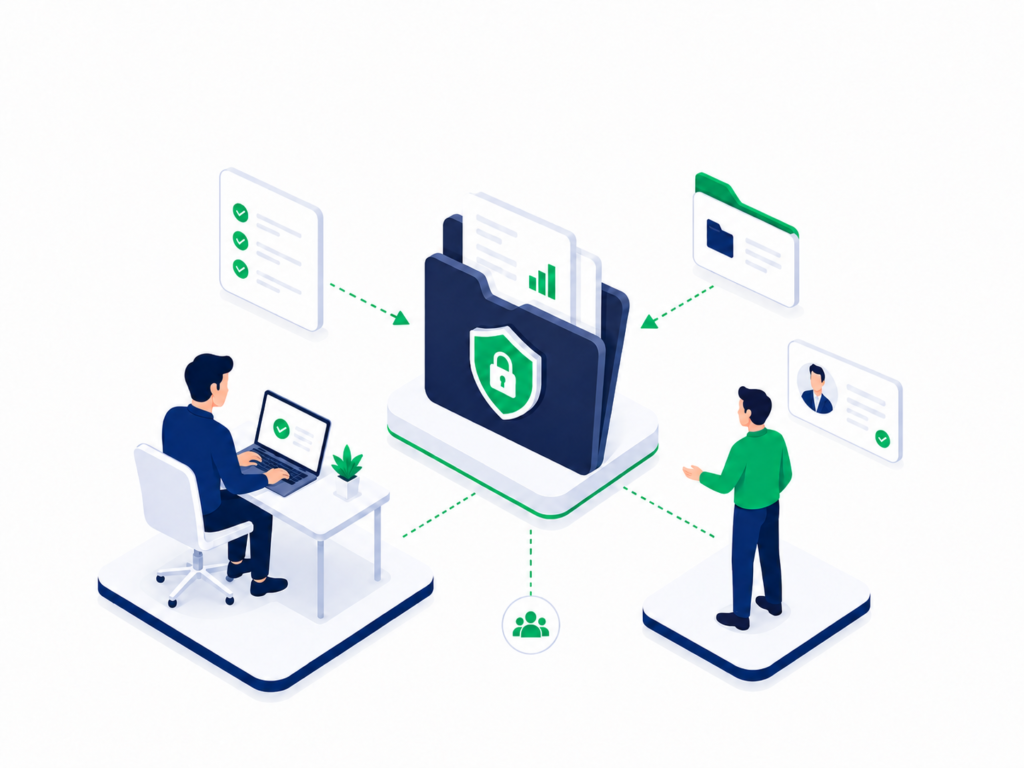
An investor data room is the evidence behind your pitch deck.
Your deck explains why the company could become valuable. The data room helps investors confirm that your financials, ownership, customer claims, contracts, and intellectual property are accurate.
A strong data room does not need hundreds of files. It needs the right documents, organized clearly and shared at the right stage of the fundraising process.
1. Use a Simple Folder Structure
Keep the data room easy to navigate.
| Folder | Main Documents |
|---|---|
| 1. Company | Incorporation documents, company structure, board and shareholder records |
| 2. Ownership | Cap table, option pool, SAFEs, convertible notes, previous investment agreements |
| 3. Financials | Historical financials, financial model, budget, burn rate, runway, use of funds |
| 4. Customers | Revenue data, customer list, contracts, retention, pipeline, case studies |
| 5. Product | Product overview, demo, roadmap, technical summary |
| 6. Legal and IP | Material contracts, IP assignments, trademarks, patents, disputes |
| 7. Team | Founder agreements, employee contracts, contractor agreements, organization chart |
| 8. Fundraising | Pitch deck, executive summary, fundraising ask, milestones, dilution model |
Add a simple index document at the top showing what is available, what is being updated, and who owns each file.
2. Company and Corporate Documents
This folder should confirm that the company is legally established and properly governed.
Include your incorporation documents, current articles or bylaws, shareholder and board resolutions, details of directors, and documents for any subsidiaries.
At an early stage, this folder may be small. That is fine. The important point is that the records are current and consistent.
3. Ownership and Previous Financing
Investors need to understand who owns the company and how the new round will change that ownership.
Include:
- Current cap table
- Fully diluted cap table
- Founder shares
- Employee option pool
- SAFEs and convertible notes
- Previous investment agreements
- Warrants or other rights to shares
- Post-round dilution model
The cap table must match the legal documents.
For example, if your spreadsheet says an adviser owns 1%, there should be a signed agreement supporting that ownership.
You can link this section to:
Building a Strong Cap Table: A Guide to Your Startup’s Ownership Structure
4. Financial Information
Your financial folder should explain how the company has performed, how it plans to grow, and how long the new funding will last.
Include:
- Historical profit and loss
- Balance sheet
- Monthly revenue history
- Current financial model
- Cash-flow forecast
- Budget
- Burn rate
- Runway
- Revenue breakdown
- Use of funds
- Debt or repayment obligations
The financial model should match the numbers in your pitch deck.
If the deck says you are raising $1.8 million for 18 months of runway, the cash-flow forecast should support that statement.
You can link this section to:
Financial Model Check: Will Your Numbers Hold Up in an Investor Meeting?
5. Customer and Commercial Evidence
This folder should prove that customers want the product and that the company understands how revenue is created.
Include:
- Customer list or anonymised customer summary
- Revenue by customer or segment
- Customer contracts
- Retention and churn
- Sales pipeline
- Pricing
- Pilot agreements
- Case studies
- Letters of intent
- Customer concentration
During early discussions, you may share an anonymised summary rather than full customer names.
For example:
| Customer Group | Customers | Annual Revenue | Retention |
|---|---|---|---|
| Small business | 64 | $310K | 88% |
| Mid-market | 18 | $470K | 94% |
| Enterprise | 3 | $290K | 100% |
Named contracts and customer references can be shared later when the investor is conducting serious diligence.
6. Product and Technology
Investors should be able to understand what has been built and what remains to be completed.
Include:
- Product overview
- Demo or screenshots
- Product roadmap
- Technical architecture
- Key integrations
- Development status
- Security overview
- Technical dependencies
Do not upload a full product manual.
The objective is to help investors understand the product, its maturity, and the main technical risks.
Highly sensitive information, such as source code or proprietary formulas, should not normally be included in the initial data room.
7. Legal, Contracts, and Intellectual Property
This folder helps investors identify legal risks and confirm that the company owns its assets.
Include:
- Material customer and supplier contracts
- Partnership agreements
- Loans and debt agreements
- Leases
- Founder IP assignments
- Employee and contractor IP assignments
- Trademarks and patents
- Privacy and data-protection documents
- Regulatory licences
- Litigation or disputes
Focus on agreements that could materially affect revenue, ownership, exclusivity, regulation, or a future sale of the company.
Do not fill the room with every minor software subscription or routine purchase agreement.
8. Team and Employment
Investors will want to confirm that the team is properly employed and that everyone who helped create the product has assigned their work to the company.
Include:
- Founder agreements
- Founder vesting terms
- Employee contracts
- Contractor agreements
- Confidentiality and IP clauses
- Option grants
- Organisation chart
- Hiring plan
- Adviser agreements
A common diligence problem occurs when a freelancer or former employee created part of the product without signing an IP assignment.
Resolve these issues before fundraising where possible.
9. Fundraising Documents
This folder should connect the round to a clear operating plan.
Include:
- Current pitch deck
- Executive summary
- Financial model
- Fundraising amount
- Proposed investment instrument
- Use of funds
- Runway
- Milestones
- Current round status
- Dilution model
- Confirmed commitments, if any
Avoid presenting only percentages for use of funds.
A clearer schedule is:
| Use | Amount | Expected Result |
|---|---|---|
| Product | $600K | Complete enterprise release |
| Commercial team | $450K | Hire four sales and customer-success employees |
| Market expansion | $250K | Launch in two additional markets |
| Operations and buffer | $200K | Maintain approximately 18 months of runway |
This helps investors understand what their capital is expected to achieve.
10. What to Share at Each Stage
Do not give every investor access to the full data room immediately.
| Fundraising Stage | What to Share |
|---|---|
| Initial outreach | Pitch deck, short company summary, website, optional demo |
| After the first meeting | Financial summary, key metrics, use of funds, high-level cap table |
| Serious interest | Full financial model, customer evidence, ownership summary, product roadmap |
| Due diligence | Corporate, financial, legal, employment, IP, customer, and tax documents |
| After the term sheet | Full restricted room, detailed contracts, tax records, final ownership documents |
| Closing | Signed agreements, approvals, updated cap table, disclosure schedules, funds-flow documents |
Some investors begin detailed diligence before issuing a term sheet. Others provide a term sheet first and complete diligence afterward.
The principle is the same: increase access as investor commitment becomes more serious.
11. Should You Ask for an NDA Before Sharing the Deck?
Usually, no.
Most professional venture investors will not sign an NDA before reviewing a standard pitch deck. They evaluate many companies in overlapping markets and do not want broad confidentiality obligations at the first-contact stage.
Your initial deck should therefore be safe to share without an NDA.
Do not include:
- Source code
- Secret formulas
- Detailed algorithms
- Unpublished patent-enabling information
- Sensitive customer data
- Security credentials
- Confidential supplier pricing
- Trade secrets
An NDA may become reasonable later when the investor needs access to genuinely sensitive technical, scientific, security, customer, or commercial information.
This is more common in deep tech, biotechnology, defense, hardware, and regulated industries.
A practical approach is:
- Share a non-confidential deck.
- Confirm investor fit and serious interest.
- Share selected supporting information.
- Use an NDA only before disclosing information that genuinely requires protection.
- Restrict the most sensitive files to named users.
12. Control Access Carefully
Use a data-room platform that allows individual access, permission controls, expiry dates, view tracking, watermarks, and access revocation.
Avoid sending one unrestricted public link to every investor.
For sensitive documents, use:
- Named-user access
- View-only permissions
- Disabled downloads
- Expiring links
- Watermarks
- Separate folders for different investors
Customer contracts, employment records, detailed ownership documents, and security information should receive stronger controls than a standard pitch deck.
13. Keep File Names Clear
Use a consistent naming structure:
Folder_Document_Company_Date
Examples:
2_CapTable_ExampleCo_2026-08-01.xlsx3_FinancialModel_ExampleCo_2026-08-01.xlsx4_RevenueByCustomer_ExampleCo_2026-07-31.xlsx6_IPAssignment_FounderName_Signed.pdf
Avoid names such as:
Final.pdfFinal_New.pdfLatest_V8.xlsxReal_Final_Updated.pdf
Investors should never need to guess which version is current.
14. Final Data Room Checklist
| Area | What to Confirm |
|---|---|
| Structure | The folders are numbered and easy to navigate |
| Pitch Deck | Only the current version is available |
| Financials | The model and historical numbers are updated |
| Cap Table | Ownership matches the legal documents |
| Customers | Traction claims are supported by evidence |
| Product | The current product and roadmap are clear |
| Legal and IP | Material agreements and IP assignments are complete |
| Team | Employment, contractor, and option documents are organized |
| Fundraising | The amount, runway, use of funds, and milestones agree |
| Access | Sensitive information is shared only at the correct stage |
| File Names | Every file has a clear name and date |
| Consistency | The deck, model, cap table, and data room tell the same story |
A Good Data Room Builds Confidence
A strong data room does more than store documents.
It shows investors that:
- The company is organized
- The founders understand their numbers
- Ownership is clear
- Customer claims can be verified
- Legal and IP risks are being managed
- The company is ready for serious investment discussions
Your data room should work together with your pitch deck, financial model, cap table, and investor outreach strategy.
At GetPitchRaise, we support early-stage founders with:
- Pitch Deck and Financial Model Assessment
- Fundraising Material Development
- Investor Outreach
Is Your Data Room Ready for Investor Due Diligence?
Book a free consultation call now to review your fundraising materials and prepare for investor outreach.
This article is for educational purposes and does not constitute legal, tax, accounting, data-protection, or investment advice.