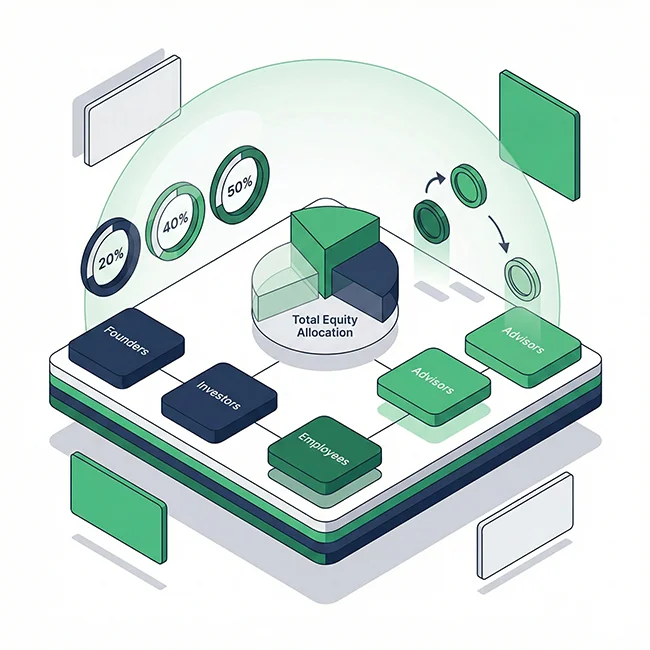
A cap table shows who owns your startup.
It records the shares, options, convertible instruments, and ownership percentages held by founders, employees, and investors. Although it may begin as a simple spreadsheet, it becomes increasingly important as the company raises capital.
A messy cap table can delay fundraising, create legal problems, and make investors question whether the company is ready for investment.
Here is how to build and maintain a healthy ownership structure.
1. Understand What Your Cap Table Should Show
A basic cap table should include:
- Shareholder names
- Number and class of shares
- Ownership percentage
- Founder equity
- Investor equity
- Employee option pool
- Convertible notes or SAFEs
- Fully diluted ownership
Investors will usually review both the current ownership and the fully diluted cap table, which assumes that outstanding options and convertible instruments have been included.
The totals should always equal 100%.
2. Avoid Giving Away Too Much Equity Too Early
Early-stage founders sometimes give away large ownership positions to advisors, employees, or small investors without considering future rounds.
For example, giving an advisor 5% may appear reasonable when the company has little value. After several fundraising rounds, that decision can significantly reduce founder ownership.
Every equity grant should reflect:
- The person’s contribution
- Their level of involvement
- The time commitment
- The company’s stage
- Standard market expectations
- Whether the equity will vest over time
Equity should be earned through meaningful contribution, not offered casually.
3. Use Founder Vesting
Founder vesting protects the company if one founder leaves early.
A common structure is four-year vesting with a one-year cliff. This means the founder earns ownership gradually rather than receiving all shares immediately.
Without vesting, a founder could leave after a few months and keep a large part of the company.
Investors often expect founder equity to be subject to vesting because it helps ensure that the founding team remains committed.
4. Create a Realistic Employee Option Pool
An employee option pool allows the company to offer equity to future team members.
Investors may ask for the option pool to be created or expanded before a funding round. This can affect founder dilution because the pool is often included in the pre-money ownership structure.
Your option pool should reflect the company’s actual hiring plan.
For example, calculate the expected equity requirements for:
- Senior executives
- Key technical hires
- Sales leadership
- Early employees
- Future management roles
Avoid creating an unnecessarily large pool simply because an investor suggests it. Ask which planned hires justify the requested size.
5. Understand the Impact of SAFEs and Convertible Notes
SAFEs and convertible notes may not appear as ordinary shares before conversion, but they can significantly affect ownership.
Founders should track:
- Investment amount
- Valuation cap
- Discount
- Interest, if applicable
- Conversion terms
- Most-favoured-nation provisions
- Pro rata rights
Several small convertible investments can create more dilution than expected when the next priced round closes.
Your cap table should include a conversion scenario so you can understand the likely post-round ownership.
6. Model Dilution Before Accepting an Investment
Before agreeing to a funding round, calculate how ownership changes.
For example, imagine the company currently has:
| Shareholder | Before Round |
|---|---|
| Founders | 80% |
| Employees | 10% |
| Existing Investors | 10% |
If a new investor receives 20% after the round, everyone else is diluted proportionally:
| Shareholder | After Round |
|---|---|
| Founders | 64% |
| Employees | 8% |
| Existing Investors | 8% |
| New Investor | 20% |
The founders still own the majority, but their ownership has fallen from 80% to 64%.
Always model the effect of the current round and at least one possible future round.
7. Keep the Cap Table Simple
Complex ownership structures can make fundraising more difficult.
Common problems include:
- Too many small shareholders
- Unclear share classes
- Verbal equity promises
- Missing investment documents
- Unrecorded transfers
- Incorrect percentages
- Different versions of the cap table
- Former employees still holding unvested options
A clean structure makes due diligence easier and helps investors understand who controls the company.
There should be one current and reliable version of the cap table.
8. Document Every Equity Agreement
Do not rely on messages, conversations, or informal promises.
Every equity transaction should be properly documented, including:
- Founder share issuance
- Advisor grants
- Employee options
- Investor shares
- Share transfers
- Convertible instruments
- Vesting terms
- Board and shareholder approvals
The cap table should match the company’s legal documents.
A spreadsheet alone does not create legal ownership.
9. Watch Founder Dilution Across Multiple Rounds
Dilution is normal. Losing too much ownership too early is the real concern.
A founder may own 100% at incorporation, 75% after a pre-seed round, 55% after seed, and less than 40% after Series A.
This may still be acceptable depending on the company’s value and fundraising needs, but it should be planned rather than discovered later.
Before each round, consider:
- How much capital is truly required
- The proposed investor ownership
- Option-pool expansion
- Existing convertible instruments
- Founder ownership after the round
- Expected dilution in future rounds
The goal is to balance ownership protection with raising enough capital to build a valuable company.
10. Prepare the Cap Table Before Investor Due Diligence
Investors may review the cap table early in the process.
Before sharing it, confirm that:
| Review Area | What to Check |
|---|---|
| Ownership | All shareholders and percentages are correct |
| Share Classes | Ordinary and preferred shares are clearly identified |
| Options | Granted, vested, exercised, and available options are separated |
| Convertibles | SAFEs and notes are fully recorded |
| Vesting | Founder and employee vesting terms are current |
| Documents | Every issuance is supported by signed documents |
| Dilution | The next-round ownership has been modelled |
| Total | Fully diluted ownership equals 100% |
Correct any inconsistencies before investors discover them.
A Strong Cap Table Supports Fundraising
Your cap table is more than an ownership record.
It helps investors understand:
- Whether the founders remain sufficiently motivated
- Whether the company has room to hire
- How much dilution the new round creates
- Whether previous fundraising was properly managed
- Whether ownership could create future complications
A clean cap table cannot replace strong traction or a compelling business. But a weak one can delay or damage an otherwise promising round.
At GetPitchRaise, we support early-stage founders through:
- Pitch Deck and Financial Model Assessment
- Fundraising Material Development
- Investor Outreach
Is Your Ownership Structure Ready for Investors?
Book a free consultation call now to review your fundraising materials and prepare for investor outreach.