
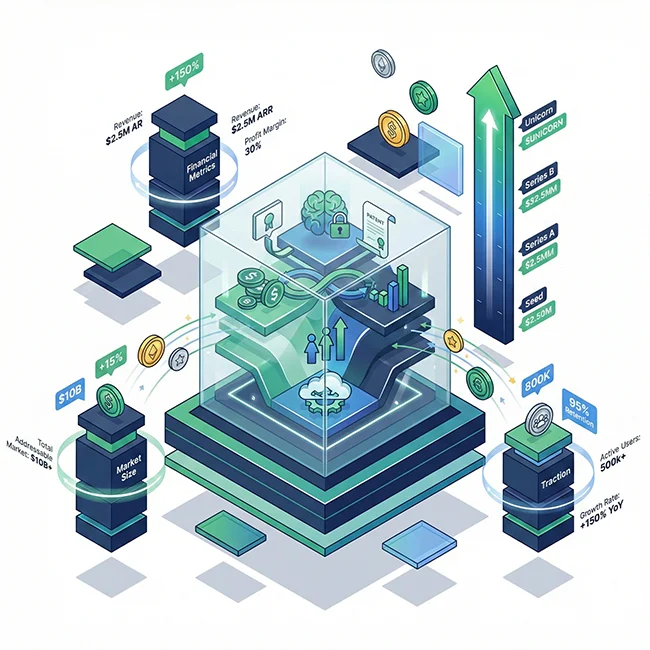
Startup valuation is one of the most difficult parts of fundraising.
Founders want to avoid giving away too much equity. Investors want enough ownership to justify the risk. The challenge is finding a valuation that reflects your company’s progress while remaining realistic for the market.
Your valuation is not simply what you believe the company could become.
It is what investors may be willing to pay today based on your stage, traction, team, market, and risk.
1. Start With Your Fundraising Stage
Valuation expectations change significantly by stage.
A pre-seed company may have little or no revenue, so investors focus more on the team, problem, market, product, and early validation.
At seed stage, investors usually expect stronger evidence, such as paying customers, growing revenue, product usage, or successful pilots.
At Series A, the company is normally expected to show a more repeatable growth model, clearer unit economics, retention, and a credible path to scale.
Do not compare your pre-seed startup with a high-growth Series A company simply because both operate in the same industry.
2. Review Your Traction
Traction is one of the strongest valuation drivers.
Investors may consider:
- Revenue and growth
- Number of paying customers
- Retention and churn
- Product usage
- Signed contracts
- Conversion from pilots
- Partnerships that generate business
- Waiting-list or user growth
For example, a startup with $40,000 in monthly recurring revenue and steady customer growth may justify a higher valuation than a company with only a concept and presentation.
The quality of traction matters too. Predictable recurring revenue is usually more valuable than one-time revenue that may not return.
3. Assess the Market Opportunity
A large market can support a higher valuation, but only when your company has a realistic way to enter it.
Investors want to understand:
- Who your first customers are
- How large that initial segment is
- How you will acquire customers
- Whether the company can expand into additional markets or products
Avoid saying:
If we capture only 1% of the market, we will become a billion-dollar company.
Instead, show how the company can win a focused segment first and expand from there.
4. Consider the Strength of the Team
At early stages, investors are placing a large bet on the founders.
A strong team may increase valuation when it brings:
- Relevant industry experience
- Technical expertise
- Previous startup experience
- Access to customers
- Strong execution history
- A clear understanding of the problem
The question is not only whether the founders are impressive.
It is whether they are the right people to build this particular company.
5. Evaluate Your Competitive Position
Your valuation may be stronger when your company has an advantage that is difficult to copy.
This may include:
- Proprietary technology
- Unique data
- Strong distribution
- Regulatory approval
- Network effects
- Exclusive partnerships
- High switching costs
- Deep industry expertise
Simply having more product features is rarely enough.
Investors want to understand why competitors cannot quickly reproduce your advantage.
6. Check Your Financial Position
Your financial model also affects valuation.
Investors may review:
- Monthly burn rate
- Current runway
- Gross margin
- Customer-acquisition costs
- Revenue growth
- Future funding requirements
- Use of funds
A startup with limited runway may have less negotiating power because it needs capital urgently.
A company with strong growth, controlled burn, and several months of runway may have more flexibility during discussions.
7. Compare Relevant Market Examples
Comparable fundraising rounds can provide a useful reference, but they should be selected carefully.
Compare companies with similar:
- Stage
- Geography
- Sector
- Business model
- Revenue level
- Growth rate
- Team strength
- Market conditions
Do not build your valuation around one highly visible startup that raised at an exceptional price.
Median market data and several relevant comparisons are usually more useful than a single headline transaction.
8. Calculate the Dilution
Valuation should be considered together with the amount you are raising.
For example, if you raise $1 million at a $4 million pre-money valuation:
Post-money valuation = $5 million
Investor ownership = 20%
If you raise the same amount at a $9 million pre-money valuation:
Post-money valuation = $10 million
Investor ownership = 10%
A higher valuation reduces immediate dilution, but it can create pressure during the next round if the company does not grow enough to justify a higher future price.
The goal is not always to achieve the highest possible valuation.
The goal is to raise enough capital on terms that support the company’s long-term progress.
9. Avoid These Common Valuation Mistakes
Founders often weaken negotiations by:
- Choosing a valuation based only on personal expectations
- Copying another startup’s valuation without proper comparison
- Ignoring current investor demand
- Setting a price that leaves little upside for investors
- Raising too little to protect ownership
- Raising too much without clear milestones
- Failing to understand dilution
A realistic valuation can create stronger investor interest and a healthier round.
A Simple Startup Valuation Checklist
| Area | Question to Ask |
|---|---|
| Stage | What level of progress is expected at our round? |
| Traction | What evidence shows that customers want the product? |
| Market | Can this become a large and scalable company? |
| Team | Why is this team well positioned to execute? |
| Advantage | What makes the company difficult to copy? |
| Financials | Are growth, burn, and runway credible? |
| Comparables | What are similar companies raising at? |
| Dilution | How much ownership will the round require? |
| Investor Demand | Are several investors interested or only one? |
| Next Round | Can the company grow into a higher future valuation? |
Valuation Is a Negotiation, Not a Fixed Formula
There is no single perfect startup valuation.
Two investors may assess the same company differently based on their strategy, portfolio, risk tolerance, and level of interest.
A strong valuation case combines credible traction, realistic financials, a large opportunity, and a clear explanation of what the new capital will achieve.
At GetPitchRaise, we support founders with:
- Pitch Deck and Financial Model Assessment
- Fundraising Material Development
- Investor Outreach
Is Your Valuation Ready for Investor Discussions?
Book a free consultation call now to review your fundraising materials and prepare for investor outreach.