One of the most common fundraising questions is:
“How much should we raise?”
The answer should not start with what similar startups raised or with the highest amount you think investors might accept.
A better question is:
How much capital do we need to reach the next milestone that makes the company meaningfully stronger?
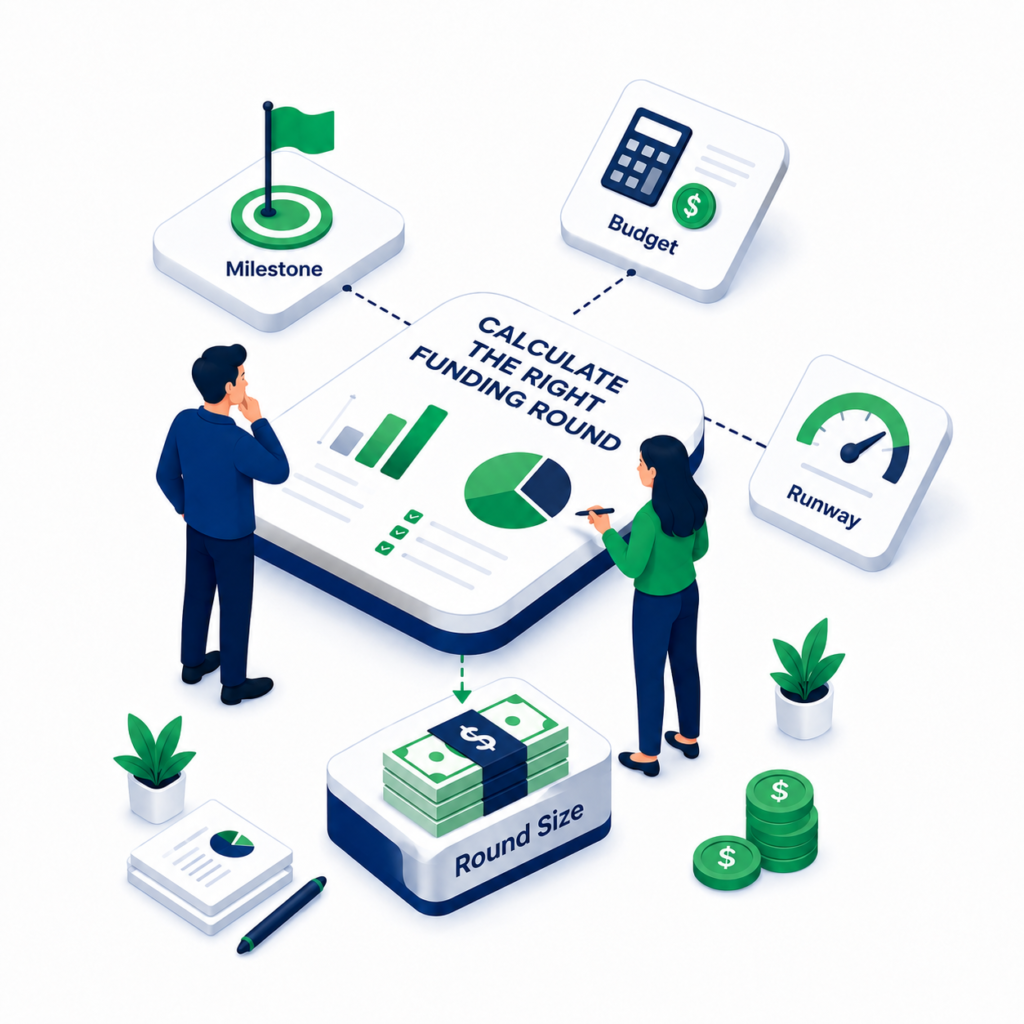
Your funding round should connect four things:
Milestones → Operating plan → Runway → Capital required
1. Start With the Milestone, Not the Number
Before deciding whether to raise $750K, $2M, or $5M, decide what the company should achieve before needing capital again.
For example:
Pre-seed
Complete the commercial product, convert five design partners, and reach the first 20 paying customers.
Seed
Grow from $400K to $1.5M ARR, build the first repeatable sales channel, and hire the core commercial team.
Series A
Scale from $2M to $6M ARR, improve retention, and establish repeatable growth across multiple markets.
The milestone determines what needs to be built, hired, and spent.
2. Calculate Your Monthly Burn
Your burn rate tells you how quickly the company uses cash.
Suppose your startup expects the following monthly expenses after fundraising:
| Expense | Monthly Cost |
|---|---|
| Team | $70K |
| Marketing and Sales | $25K |
| Technology | $12K |
| Operations | $10K |
| Legal and Other | $8K |
| Total Monthly Expenses | $125K |
If the company generates $35K in monthly cash revenue, the approximate net burn is:
$125K expenses − $35K revenue = $90K net monthly burn
But do not assume burn stays flat.
If you plan to hire six people after the round, monthly burn may increase significantly over the next year.
Your financial model should show that change month by month.
For a deeper review, link to:
Financial Model Check: Will Your Numbers Hold Up in an Investor Meeting?
3. Decide How Much Runway You Need
Runway is how long the company can operate before needing more capital.
For many early-stage startups, founders often plan around roughly 12–24 months, depending on stage, business model, market conditions, and the milestones being targeted.
The important point is not choosing a standard number.
Ask:
How long will it realistically take us to reach the next fundraising milestone?
If your plan requires:
- 3 months to recruit
- 6 months to launch
- Another 6 months to prove traction
- Several months to prepare and raise the next round
Then a very short runway may put the company back into fundraising before it has created enough new evidence.
4. Add One-Time Costs
Monthly burn does not capture everything.
You may also need capital for:
- Product development
- Equipment
- Inventory
- Regulatory approval
- Market-entry costs
- Security certification
- Legal work
- Manufacturing setup
- Deposits
- Major software implementation
Example
Assume:
Expected operating burn for 18 months: $1.5M
Product and market-entry costs: $250K
Current available cash: $300K
Your preliminary funding requirement may be around:
$1.45M before adding a contingency buffer.
This is much stronger than simply deciding:
“Seed rounds in our industry seem to be around $2 million, so let’s raise $2 million.”
5. Include a Buffer
Your base-case forecast will probably not happen exactly as planned.
Customers may sign later. Recruitment may take longer. Revenue may grow more slowly. Legal or product costs may increase.
Include a reasonable contingency.
For example:
| Requirement | Amount |
|---|---|
| Operating plan | $1.50M |
| One-time costs | $250K |
| Contingency | $200K |
| Less existing cash | ($300K) |
| Target Round | $1.65M |
The buffer should protect the operating plan, not simply inflate the round.
Too little funding may force you back into the market before reaching the milestone investors expect.
6. Connect Every Major Dollar to a Result
Investors will ask:
“What does this $2 million actually achieve?”
Avoid giving only spending percentages.
Less useful
40% product
35% sales and marketing
25% operations
Better
| Capital Use | Amount | Expected Outcome |
|---|---|---|
| Product and Engineering | $650K | Complete enterprise product |
| Commercial Team | $550K | Hire sales lead and three account executives |
| Market Expansion | $300K | Launch in Germany and Netherlands |
| Operations and Buffer | $250K | Support approximately 18 months of runway |
| Total | $1.75M | Reach the next major fundraising milestone |
Investors are interested in spending, but they care even more about the progress created by that spending.
7. Check Whether the Round Creates Enough Progress
Imagine two companies.
Company A
Raises $800K and reaches:
$350K ARR → $600K ARR
Company B
Raises $1.5M and reaches:
$350K ARR → $1.5M ARR with a repeatable sales process
Company B is raising more capital, but it may reach a much stronger position for the next financing.
The right round is not always the smallest possible round.
It should be sufficient to create a meaningful increase in company value and reduce important investment risks.
8. But Do Not Raise More Just Because You Can
There is also a downside to raising too much.
A larger round may mean:
- More dilution
- Higher valuation expectations
- Greater pressure to grow quickly
- A larger team before the business model is proven
- Higher monthly burn
- More difficult expectations for the next round
If the company only needs $1.5M to reach the next major milestone, raising $4M may encourage unnecessary spending.
Capital should support the strategy, not replace it.
9. Check the Dilution
Round size and valuation must be considered together.
Suppose you raise $2M.
| Pre-Money Valuation | Post-Money Valuation | Approx. New Investor Ownership |
|---|---|---|
| $6M | $8M | 25% |
| $8M | $10M | 20% |
| $10M | $12M | 16.7% |
This simplified example does not include SAFEs, convertible notes, or option-pool changes, which may create additional dilution.
Founders should model the full post-round ownership before accepting an investment.
Internally link to:
Building a Strong Cap Table: A Guide to Your Startup’s Ownership Structure
and:
SAFE vs Convertible Note vs Equity Round: Which Should You Raise?
10. Consider the Minimum Round You Can Close
Your target may be $2M, but ask:
What is the minimum amount that still allows the plan to work?
Perhaps:
- Target round: $2M
- Minimum viable close: $1.4M
If only $1.4M closes, you may delay two hires and postpone one market launch while still reaching the most important product and revenue milestones.
Having a minimum-close plan helps you respond when fundraising conditions change.
11. Make Sure the Next Round Is Considered
Do not plan only until the bank account reaches zero.
Your company should ideally begin the next fundraising process before runway becomes critical.
Suppose your $1.8M round provides approximately 18 months of runway.
If the next institutional fundraising process could take several months, you may need to start preparing around month 12 rather than waiting until month 17.
That means the milestones investors will evaluate in the next round need to be visible early enough.
Internally link to:
Startup Fundraising Timeline: What to Do 12 Months Before You Raise
A Simple Funding-Round Framework
Use this structure:
Capital required = Operating burn + One-time investments + Contingency − Existing available cash
Then test that amount against:
| Question | What to Check |
|---|---|
| Milestone | What should be achieved before the next round? |
| Runway | Is there enough time to achieve it? |
| Burn | How will monthly spending change after hiring? |
| Revenue | Are projected cash inflows realistic? |
| Buffer | What happens if growth is slower? |
| Dilution | How much ownership will the round require? |
| Minimum Close | What is the smallest workable round? |
| Next Round | Will the company reach a stronger financing position? |
Example: Calculating a Seed Round
Consider a B2B SaaS startup currently at $400K ARR.
Its goal is to reach $1.6M ARR and establish a repeatable sales channel.
The company expects:
| Requirement | Amount |
|---|---|
| Team and operating costs | $1.25M |
| Sales and marketing | $350K |
| Product development | $250K |
| Market expansion | $150K |
| Contingency | $200K |
| Less existing cash | ($300K) |
| Estimated Raise | $1.9M |
The fundraising story becomes:
We are raising $1.9 million to expand the commercial team, complete the enterprise product, and grow from $400K to approximately $1.6M ARR while maintaining sufficient runway to reach the next financing milestone.
That is much easier for an investor to evaluate than:
“We want to raise around $2 million because that seems appropriate for a seed round.”
Raise Enough to Reach the Next Meaningful Milestone
There is no universal perfect round size.
A $750K round may be appropriate for one startup while another genuinely needs $4M.
The right amount comes from your operating plan.
Start with:
Where are we today?
Then ask:
Where must we be before we need investors again?
Finally calculate:
What resources and runway will realistically get us there?
At GetPitchRaise, we support early-stage founders through:
- Pitch Deck and Financial Model Assessment
- Fundraising Material Development
- Investor Outreach
Not Sure How Much Your Startup Should Raise?
Book a free consultation call now to review your fundraising materials and prepare for investor outreach.